
Main Article: Celebrating 100 Years of Storytelling
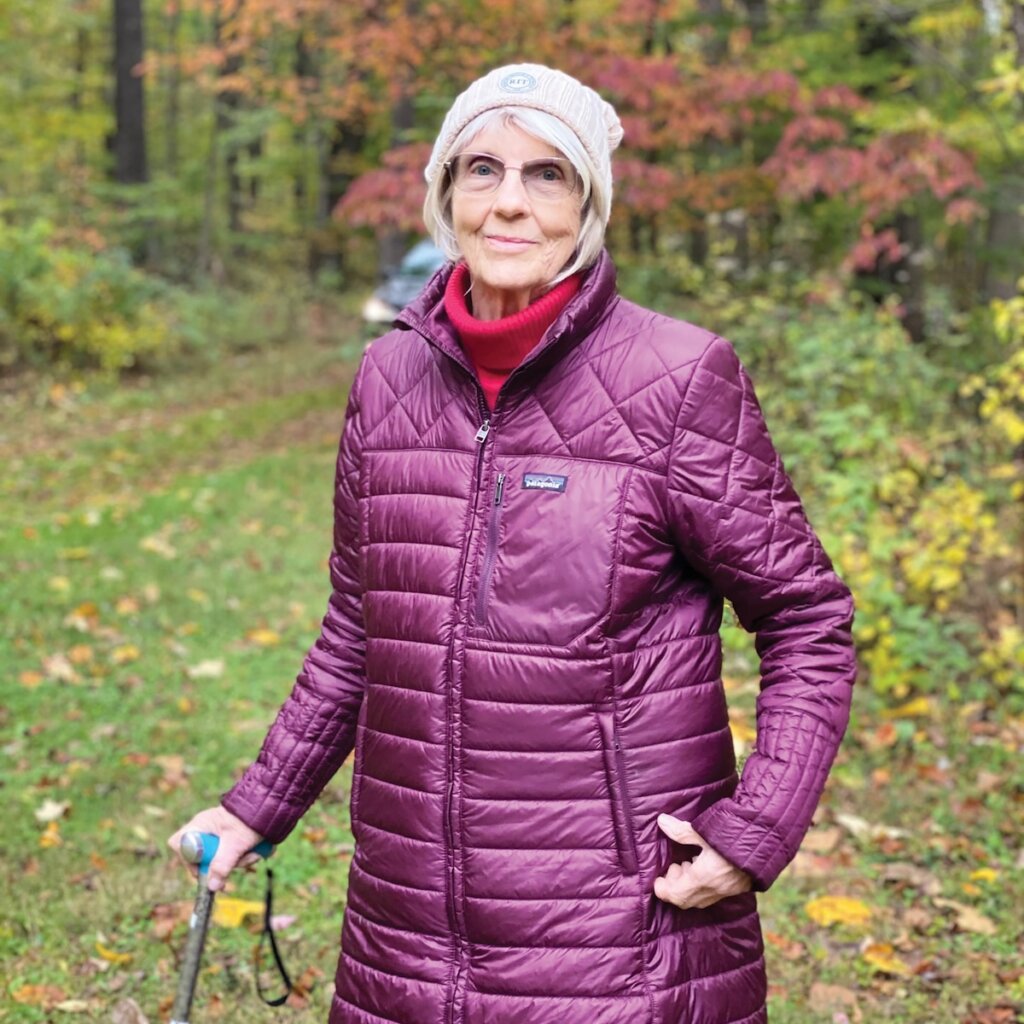
Sitting in her senior living apartment in Ithaca, New York, Lee Ann Bowman pages through a cache of Punahou Bulletin issues she has treasured for decades. She held on to the collection so dearly that she brought it with her when she moved from her longtime home in Hawai‘i last year.
She slips out an issue from Winter 1977 and begins to read. One article welcomes three new members of the Board of Trustees: Julia Sia ’46 Ing, Suyeki Okumura (1929) and Maurice Sullivan. “I remember meeting them. They were such nice people,” she says. Another story catches her eye, describing how the Class of 1953 planned its Lū‘au. She reads aloud: “Wine and beer at a nominal charge will be served starting at 5 p.m. Stuart Ho ’53 and Albert Lemes ’53 will be supervising.”
As Bowman continues leafing through the magazine, a bright laugh escapes her, filling the quiet calm of her new home. The protagonists in this next article are Punahou President Roderick McPhee, his friend Dr. R. B. Cloward and a very unfortunate bird.
She pauses, then reads with amusement. “Dr. Cloward accidentally killed the bird on the Waialae Golf Course. A bird lover, he decided to have it stuffed and mounted, but discovered it was on the endangered species list, so the local taxidermist could not touch it without special permission from the United States government.”
She reaches the punchline. “The process took two years, so Mrs. Cloward had to keep the bird in a freezer,” Bowman says, breaking into laughter. “They even gave it a name: the Punahou Plover. This is so funny.”
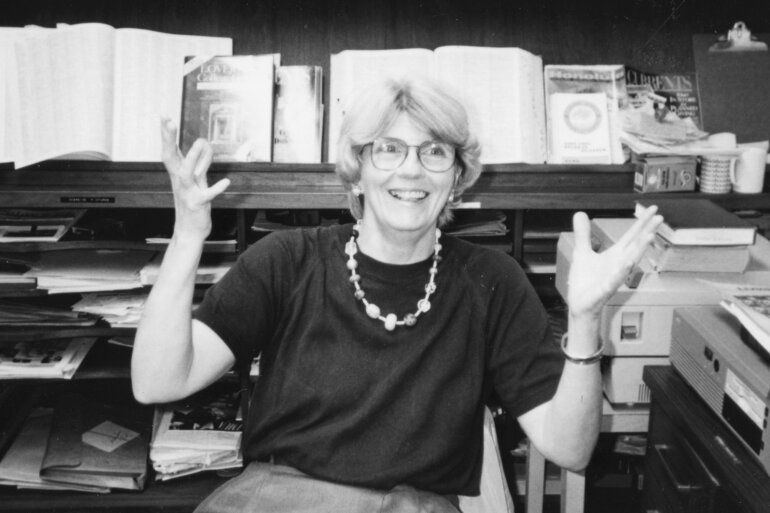
Now in her 80s, Bowman became editor of the Punahou Bulletin in 1976 and served as its principal storyteller for two decades. She remembers that time fondly. “I was so happy when I got the job,” she says. “But I was also scared because I did not know anything about how the School worked. I was not an alumna and did not have any ties to the community.”
Bowman’s path to Hawai‘i is its own story. Born and raised in northern Minnesota, she graduated from high school and enrolled at the University of Minnesota in 1972. There, she crossed paths with kama‘āina Pierre Bowman in a Journalism 101 class. They eventually married, moved to Hawai‘i and raised two children.
Her early career included a jack-of-all-trades role with the United States Bicentennial, a series of commemorative events in the mid-1970s marking the nation’s founding. In Hawai‘i, the effort was chaired by Thurston Twigg-Smith ’38, longtime trustee and generous Punahou supporter. Impressed by Bowman’s writing, he encouraged her to apply for the Bulletin editor position, which was opening with the retirement of Martha Clifford ’41, who had led the magazine since the 1960s.
Bowman interviewed extensively, including with President McPhee. When the offer arrived, she stepped into her new role with equal measures of excitement and humility. “It was a brand-new world,” she says. “I had so much to learn about Punahou’s traditions, its rich history, and keeping track of class years. The list of what I did not know was a mile long. I still do not know how I got the job. I was just an ordinary person, and suddenly I was the editor of the Punahou Bulletin.”
She proved anything but ordinary. A fast learner with a natural gift for storytelling, Bowman chronicled many milestone moments: the modular schedule trickling down to the Junior School, the completion of the Nancy Spalding Memorial Tennis Courts, the first group of Punahou students to visit China and major repairs at the President’s home. She authored these stories, and countless others, with care and intention.
It was a wonderful experience for me. I loved the people I met and everything I learned. For 20 years, I made new discoveries every single day. What more can you ask for?
– Lee Ann Bowman, Editor 1976 – 1996
Still, she credits much of her success to the supportive network she found at Punahou. She especially remembers Class Correspondents Margaret Smith (1922) Young and Lucinda Smith (1927) King “I had the encouragement and help of so many people, but Margaret and Lucinda stand out,” she says. “They truly wanted me to succeed. Margaret could be strict at times, but I could tell she wanted me to grow.”
She also felt bolstered by her predecessor. “When my first Bulletin issue was printed, I got a call from Martha Clifford,” she recalls. “She wanted to congratulate me on a job well done. That meant so much because she was an alumna and so good at what she did.”
Bowman joined the magazine at a moment of transition. The year before she became editor, the School introduced the Class Correspondent system, which remains the backbone connecting more than 35,000 alumni around the world. Before that shift, the editor was largely responsible for writing Alumni Notes, leaving little time for broader storytelling about life at the School.
That changed under President McPhee, who wanted the publication to highlight engaging classes, special speakers and campus happenings. “The Bulletin was evolving,” Bowman says. “It was becoming more than just Alumni Notes.” Working as a one-woman shop, she developed sources, wrote articles and even took photographs.
One of her favorite topics was the Outdoor Education program, launched in the early 1970s. “I remember how wonderful it was for the community,” she says. “Kids learned about nature and went on camps. There was so much excitement around it.”
She also experienced major shifts behind the scenes. Early on, she typed stories on a typewriter and sent them out for typesetting and printing. Later, the Bulletin brought typesetting in-house. “That was a big change,” she says. “Although still nothing like today.”
Above all, Bowman enjoyed writing about people. “When I received a tip, I would get so excited,” she says. “There were so many people doing meaningful things. I could not wait to learn more about them and share their stories.”
Reflecting on her two decades at Punahou, she has a few insights for future editors. “When people are critical, listen with an open mind,” she says. “Maybe they are trying to help you, not hurt you.”
She also encourages embracing the role as a chance to grow. “It was a wonderful experience for me. I loved the people I met and everything I learned,” she says. “For 20 years, I made new discoveries every single day. What more can you ask for?”