
Main Article: Celebrating 100 Years of Storytelling

Punahou’s Creative Director David Cox has been the design architect behind the Punahou Bulletin for 22 years. Before settling into his career at the School, however, he followed a path with plenty of twists and turns.
Raised in Washington state, Cox spent 11 years in the food services industry after high school, channeling his creativity as a chef, cake decorator and production baker. In 1991, he went back to school and earned a certificate in design from Seattle Central Community College.
His first job after the two-year program was at Nordstrom Advertising, where he helped artists transition from analog methods to the emerging world of digital design. During his years in Seattle, he worked at several prestigious design firms, honing his skills on everything from black-and-white newspapers to cutting-edge retail advertising.
Cox moved to Hawai‘i in 2000 and worked with a range of nonprofits and advertising agencies before joining Punahou’s Communications Department on Jan. 4, 2004. At the time, the Bulletin was a far cry from the publication it is today. Covers tended toward muted colors, interior pages were still largely black and white, and the bold imagery that is now a visual hallmark of the magazine was far less common.
What keeps Cox engaged after more than two decades of designing the Punahou Bulletin? “Every issue is an adventure,” he says. “What I do is very much like an experimental playground.” With each creative journey, he tries new approaches, learns from the process and stretches himself artistically. “It keeps things fun.”
Over the years, Cox has collaborated with many editors and served as the design mind behind more than 85 Punahou Bulletin issues. He also oversees visual branding across the School, including brochures, print collateral and posters. Cox has also lent his eye for interior design elements in projects such as the Mary Kawena Pukui Learning Commons.
This fall, with support from Punahou Archives Director Kylee Mar, Cox revisited 100 years of Punahou Bulletins – including the many he designed. In a session held at Castle Hall, he was asked to select a handful of highlights from his prolific body of work. He chose the following seven covers featured here.
They stand out for a host of reasons, especially for breaking new ground in design or representing “firsts” for the magazine. Revisiting these covers was a powerful reminder of Cox’s legacy and of how his work has helped to define the look of the Bulletin over the decades, a journey shaped by connection, creativity and joyful experimentation.

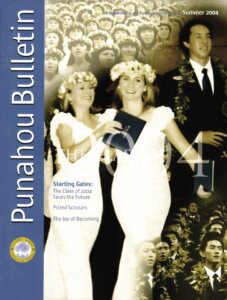
2004 – First Cover
Cox joined Punahou after nearly three and a half years as a senior art director at a boutique firm in downtown Honolulu. “I was used to having a decent budget for the design work we produced,” he says. “So I was challenged when I began working on the Punahou Bulletin and had to assemble the magazine on a shoestring budget.” At the time, he sifted through boxes of 5-by-7 snapshots to gather visual content. The process was labor intensive and would soon evolve.
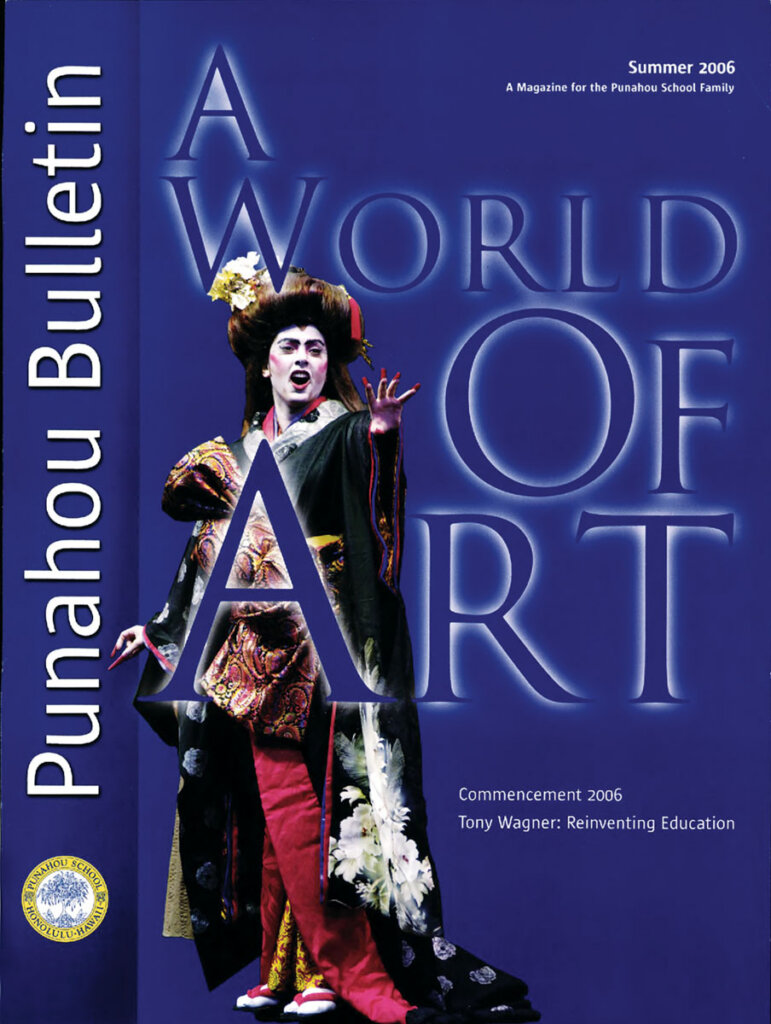
2006 – A World of Art
Shortly after moving to Honolulu, Cox worked with an advertising mentor who shared one piece of advice that stayed with him. “He would always tell me to treat every spread like a poster,” Cox recalls. “So when I look at design, I always keep that in mind.” Often, creating that impact was difficult because the available imagery was limited. “Many of the photos coming to me were 5-by-7 snapshots taken by members of the Punahou community,” he says. “They were perfectly nice, but not strong enough to make a big visual statement.”
That changed when long-time campus photographer Kathleen Connelly began capturing life at Punahou. Her arrival transformed the School’s storytelling capabilities. The cover image of a student in theatrical Japanese attire and makeup was a turning point. “It was such a striking photo,” Cox says. “I was finally able to create a cover that felt like a poster, and that felt good.”

Fall 2009 – PUEO: Reaching for College
The path to a Bulletin cover is rarely straightforward, and this issue was no exception. The concept began with a photoshoot of Partnerships for Unlimited Educational Opportunities (PUEO) Scholars at a farmers’ market in Mānoa. “The pictures were lovely,” Cox says, “but nothing was leaping out as a hero shot.” The creative team improvised, asking five Scholars to gather and place their hands together. “When I saw those images coming through, I knew we had our cover.” The photograph conveyed community and ambition, creating the sweet spot that Cox describes as “a strong verbal and visual equation.”
This issue is also notable for another reason. For decades, the Bulletin’s masthead had strip of color running vertically along the left edge. When Cox arrived, he adhered to the traditional design for some time, but he hoped to quiet the visual weight of the strip so that the cover imagery could play a larger role. He started making the color gradually transparent with each issue until it disappeared altogether for this cover. “I wanted to make room for imagery that was visually striking,” he says. “That’s when the Bulletin began to feel more like a magazine.”
Spring 2019 – A Celebration of Music
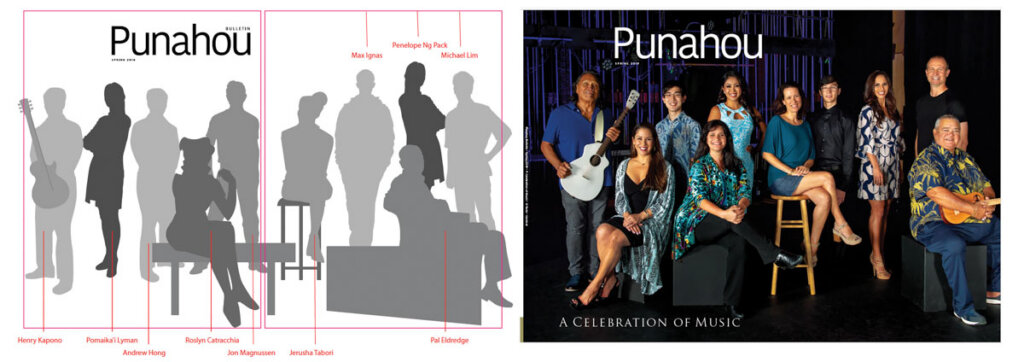
This issue commemorated the 100th anniversary of the Music School. The cover featured alumni from several generations as well as two current students who had been shaped by the gift of music. It was also the first Bulletin to publish a fold-out cover featuring a group portrait. In total, ten musicians participated.
Cox prepared meticulously, sketching the placement of each subject to guide the camera and lighting setup. “I was a bit nervous because it was our first time attempting something like this,” he says. Once everyone arrived, small adjustments were needed based on attire and height, but the advance planning paid off. “When the day came, everything moved quickly and smoothly,” he recalls.
Winter 2020 – Our Stories: Life in the Pandemic
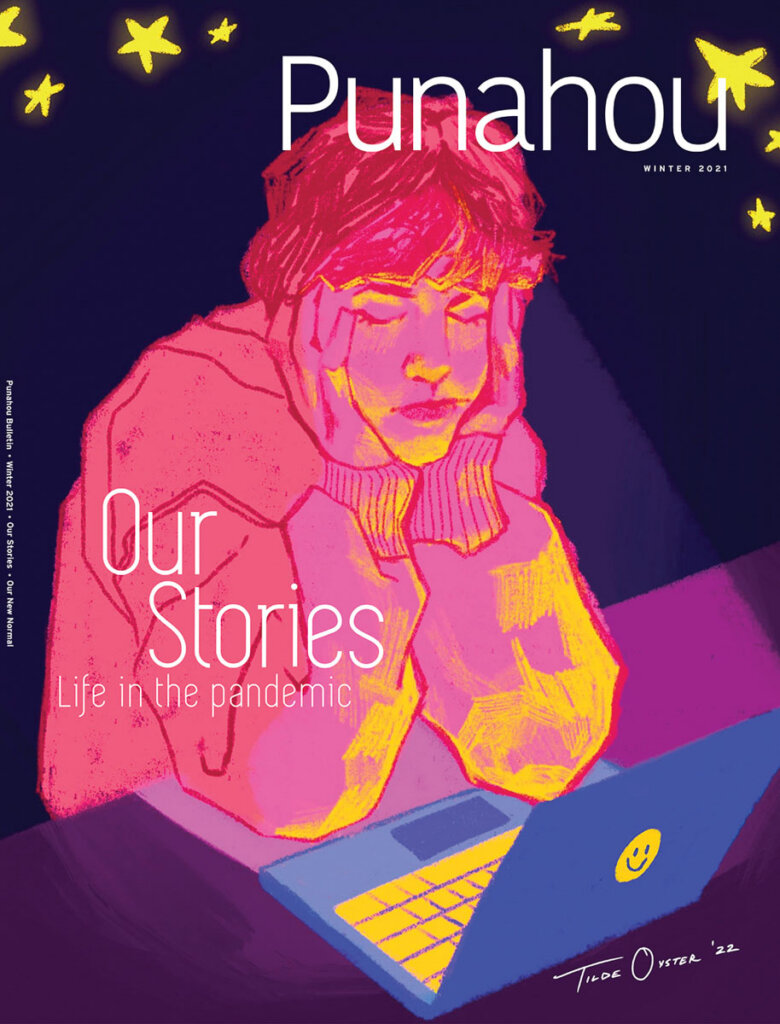
Although the pandemic was a somber period, Cox remembers moments of collaboration and creativity. This cover stands out because it was illustrated by Academy student Tilde Oyster ’22, a rare distinction in recent history. “She captured the angst of that moment, but did it with a sense of optimism through her color choices and even the small smiley-face emblem on the laptop,” he says.
Oyster later created four illustrations for a feature on college admissions in the fall 2021 issue. At the time, she was in the midst of her own applications, which added a layer of authenticity to her work. Cox mentored her through the process and wrote a letter of recommendation.
Fall 2023 – Future Forward
The focal point of this issue explored how Punahou is preparing students for a rapidly changing world through a rich portfolio of courses across all grades. Appropriately, the cover itself marked a unique, creative milestone. It was crafted through a collaboration between student designer Isabel Cheever ’23 and Midjourney, a generative AI platform.

After reviewing the thesis of the “Future Forward” feature, Cheever drafted prompts that Midjourney used to render an illustration of a student holding a globe. It took multiple rounds of refinement to align the image with the editorial message. Even after the final output was generated, the design team made additional edits, including removing an extra six-fingered hand that appeared beside the globe.
Winter 2025 – The Arts at Punahou
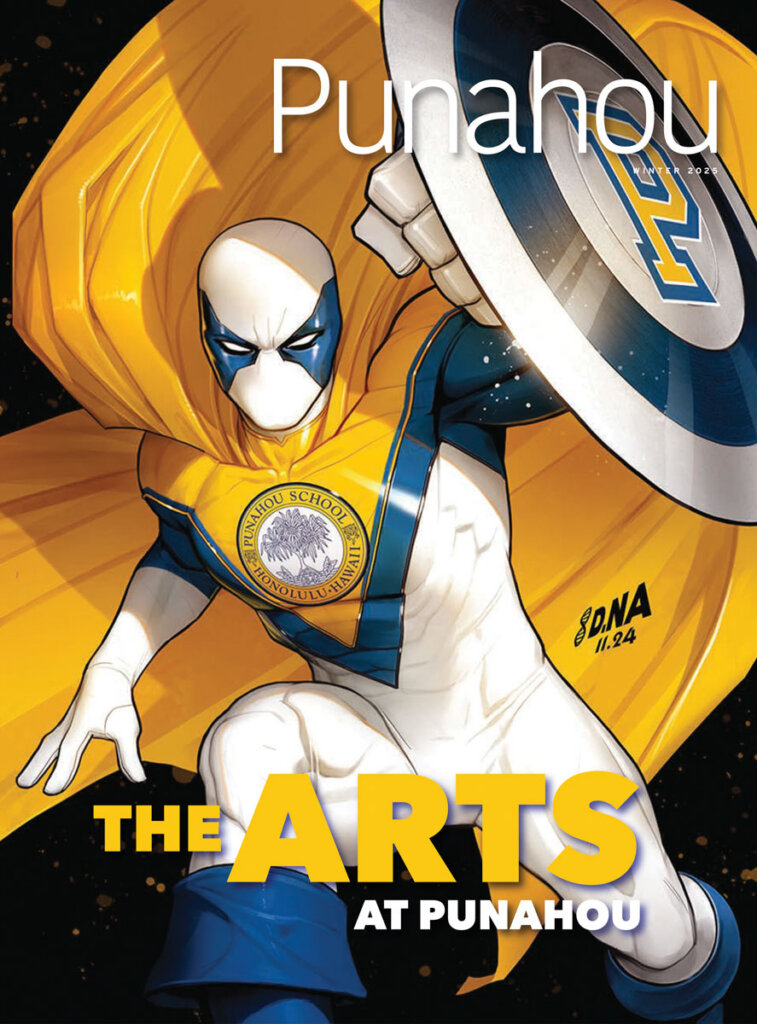
This issue was inspired by the evolution of artistic expression at Punahou since its founding in 1841. The cover was created by David Nakayama ’97, an acclaimed artist known for his work with DC and Marvel Comics. Cox appreciates the piece not only for its visual impact but also because it broke new ground. It is believed to be the first time a superhero was featured on the cover of the Punahou Bulletin.
Working with Nakayama was a lively process. From the outset, everyone knew the superhero’s colors would be buff and blue. Nakayama submitted several studies that emphasized qualities such as courage, creativity and a willingness to take risks, echoing the traits of an artist. The final illustration captures that spirit and stands as a vivid symbol of the arts at Punahou today.