

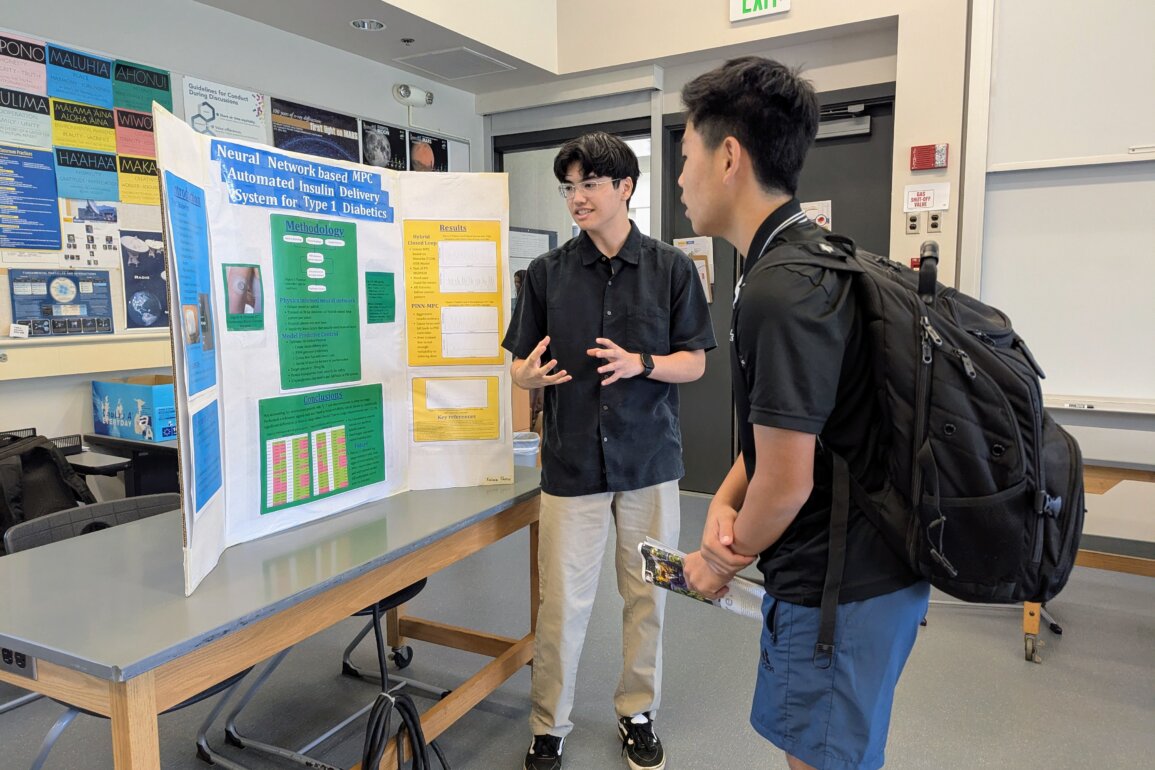
Students in Punahou’s Research Experiences in Science class shared the culmination of their semester-long investigative work at a public poster session on Tuesday, Dec. 9. Guided by Science Faculty member Tiffany Coke, the eight student researchers spent months designing independent projects, collecting and analyzing data, and refining their skills in scientific communication.
Research Experiences in Science is a hands-on course that introduces students to real-world scientific inquiry, mirroring the collaborative methods used in university research settings. Each semester focuses on a scientific field such as astronomy, chemistry, physics or biology, while still allowing students to pursue independent research topics of their choice. Through guest speakers, data analysis, and poster presentations modeled after professional conferences, students gain practical research experience and develop the ability to communicate complex scientific ideas effectively.
To enrich this semester’s poster session, the class invited the five guest speakers who had met with students over the past few months. Three University of Hawai‘i professors were able to attend and they engaged students with the kinds of probing questions they pose to their own research teams, offering an authentic taste of real-world scientific dialogue.
Each project highlighted an introduction, methodology, results and conclusions – offering visitors an accessible window into advanced scientific inquiry. The topics reflected an impressive breadth of curiosity, ranging from biomedical engineering to astrophysics, climate science and marine biodiversity. Student investigations included:
- Neural network–based automated insulin delivery systems for Type 1 diabetes
- Environmental quenching and kinematic suppression in galaxy groups
- How temperature influences ferrofluid performance in sealing leaks
- Shifts in Eastern Pacific cyclogenesis patterns under climate oscillations
- Correlations between high-energy neutrinos and rare astrophysical events
- Reef fish biodiversity in managed and unmanaged marine sites around Oʻahu
The event invited Punahou faculty and staff to meet the students, ask questions and engage with the scientific process firsthand. “It was a celebration of curiosity and persistence,” said Coke. “Students learned not only how to conduct research, but how to share it – an essential part of science.”
The session offered a vibrant showcase of emerging scientific voices and highlighted the depth of learning that takes place in this unique, research-driven course.


Photos by Tiffany Coke