

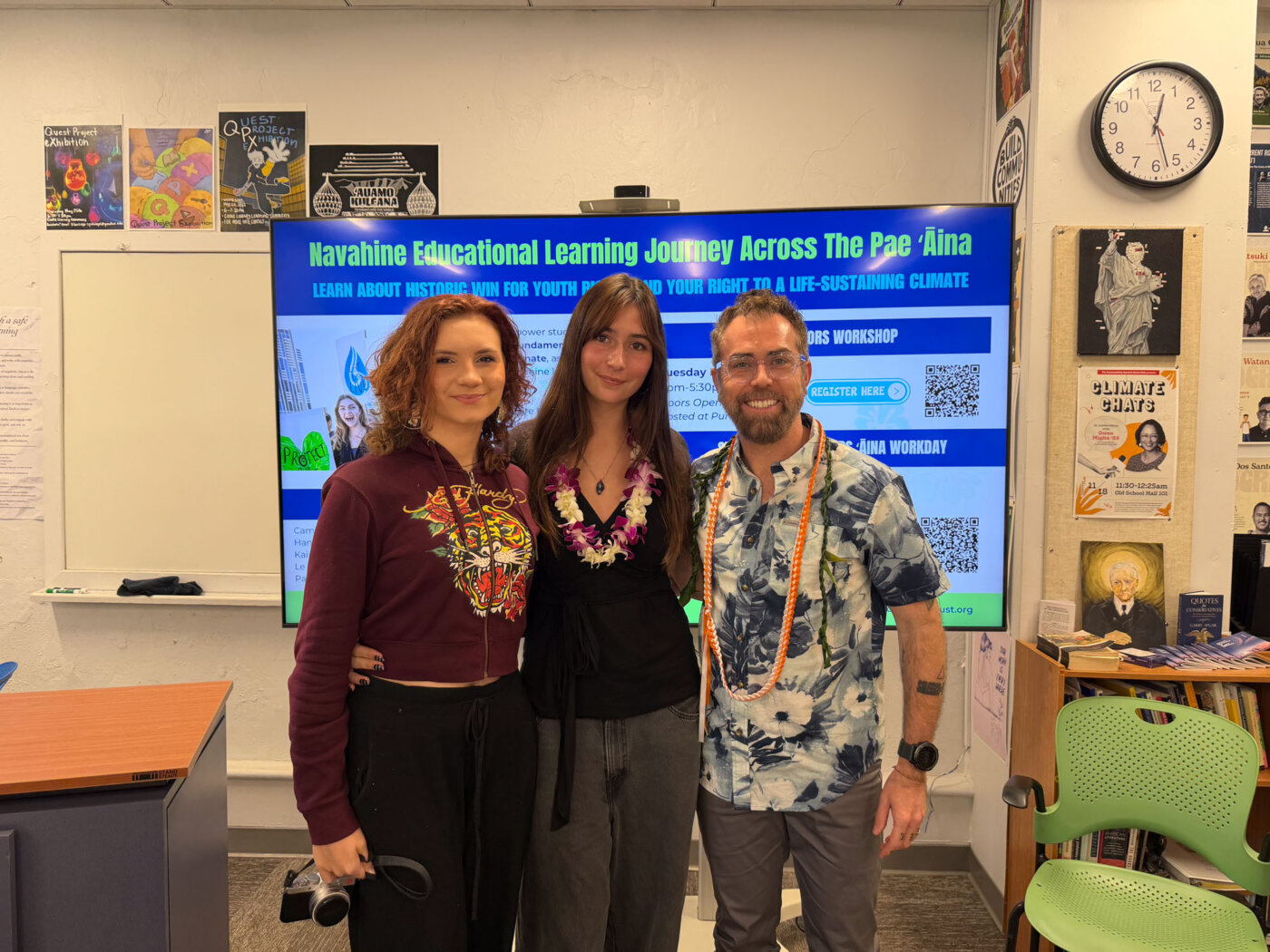
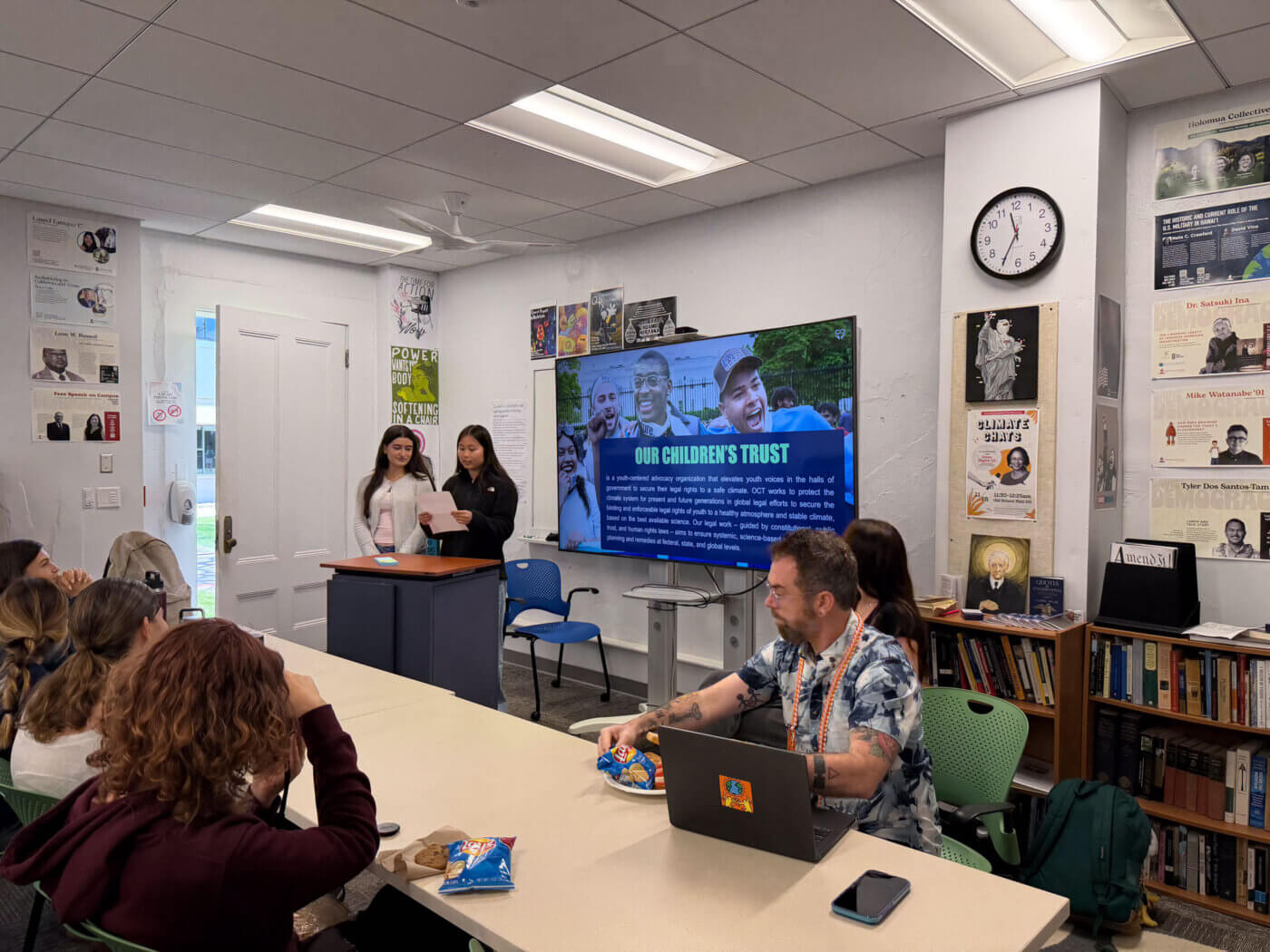
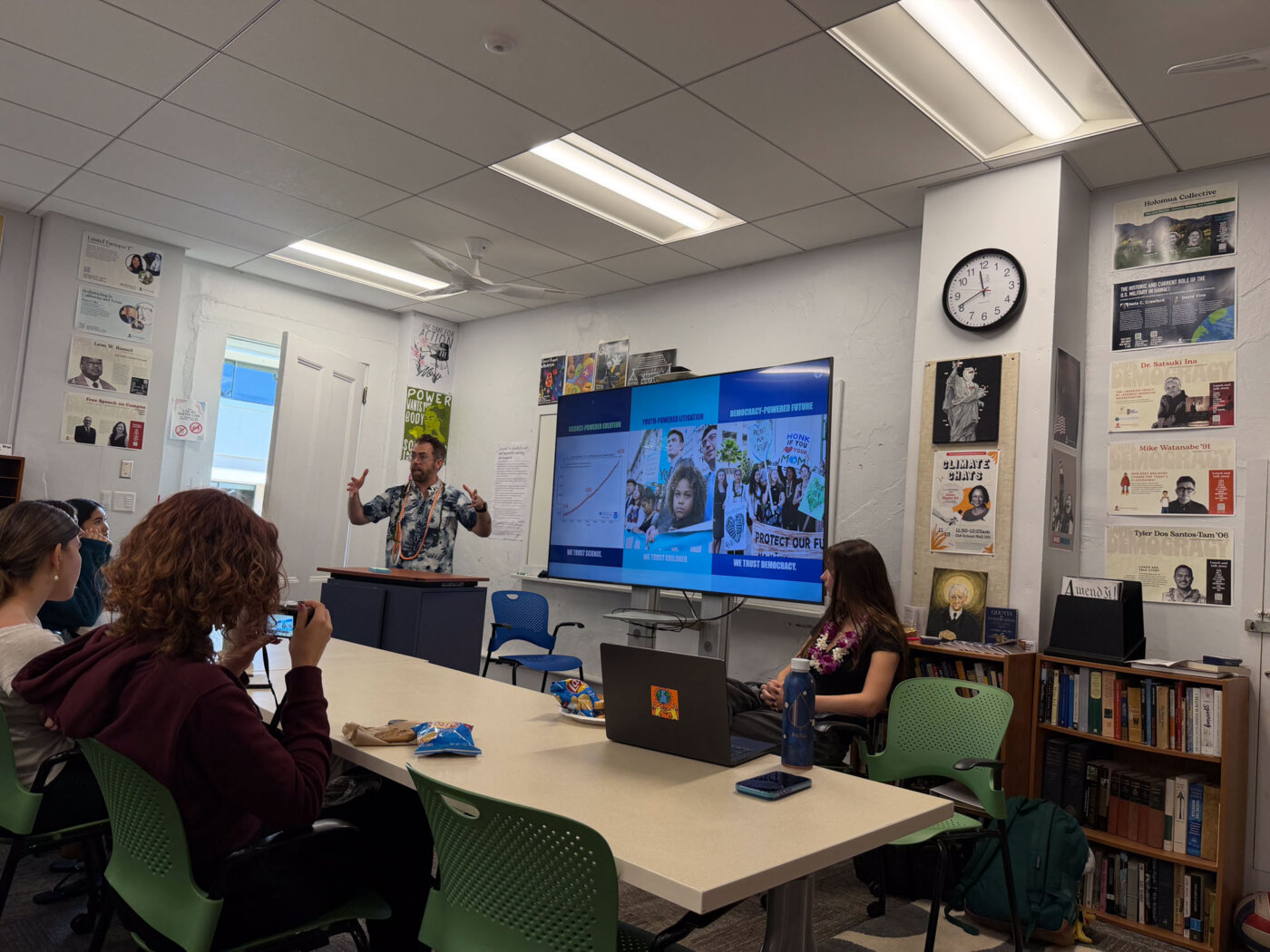
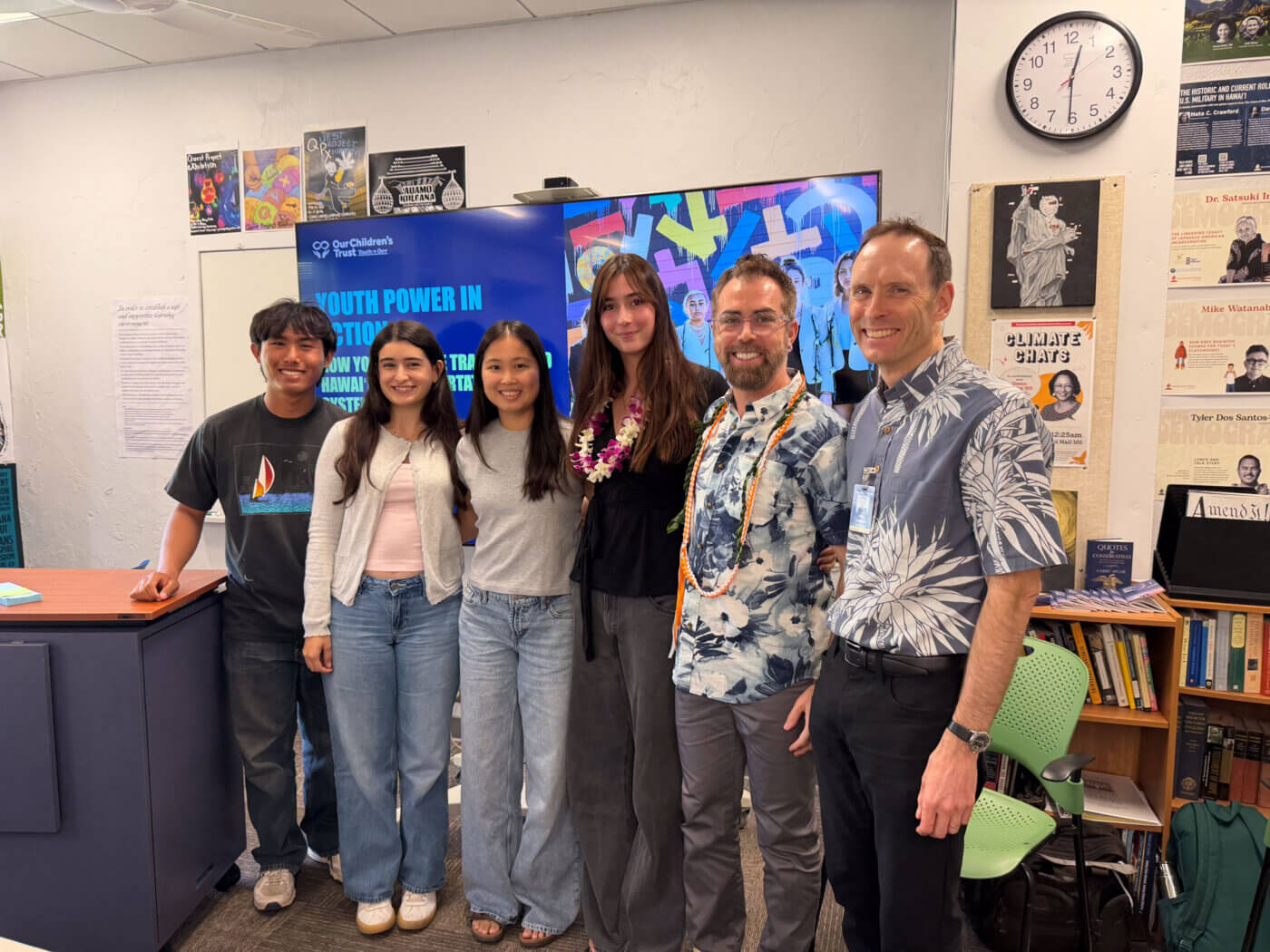
Punahou School welcomed Mat dos Santos, Co-Executive Director and General Counsel of Our Children’s Trust, as part of the Navahine Learning Journey – a statewide educational initiative bringing climate justice conversations to students across Hawaiʻi. The program was sponsored by the Davis Democracy Initiative and Punahou’s Sustainability program.
Founded on the belief that young people have a constitutional right to a safe and stable climate, Our Children’s Trust is a nonprofit organization that represents youth in legal actions against governments, advocating for science-based climate solutions. Through youth-powered litigation, the organization has worked across the United States and internationally to hold institutions accountable for protecting the environment for future generations.
Dos Santos, a nationally recognized civil rights and environmental attorney, leads this work. Prior to joining Our Children’s Trust, they served as Legal Director of the ACLU of Oregon, where they advanced cases involving civil liberties, immigrant rights and social justice. Today, they oversee a global legal program focused on climate litigation on behalf of young people – amplifying their voices in courtrooms and public discourse alike.
At Punahou, dos Santos spoke alongside Charlotte Madin, a University Laboratory School junior and one of the 13 youth plaintiffs in the landmark case Navahine v. Hawaiʻi Department of Transportation. Their presentation highlighted how a group of Hawaiʻi students, ranging in age from 8 to 18, brought forward a first-of-its-kind lawsuit asserting their constitutional right to a life-sustaining climate.
The resulting settlement is historic. It commits the State of Hawaiʻi to decarbonize its transportation sector by 2045, placing the process under court supervision and aligning it with the best available climate science. The agreement also established the Hawaiʻi Youth Transportation Council, ensuring that young people continue to have a voice in shaping policy. Early efforts include expanding electric vehicle infrastructure, advancing a multimodal transportation network and planting thousands of native trees.
Throughout the visit, students engaged in thoughtful dialogue about civic responsibility, sustainability and the role of youth in shaping public policy. Dos Santos emphasized that one of the greatest challenges ahead is cultural – shifting mindsets from individual consumption toward collective responsibility. Madin reinforced that message, encouraging students to speak up, stay informed and take action: “Our voices matter, and they can create real change.”
Punahou hosted both a lunchtime talk and an educator workshop, offering opportunities for students and faculty to explore how education, law and community engagement intersect in addressing climate change. These conversations are part of a broader effort to empower the next generation of leaders with the knowledge and tools to advocate for a more sustainable future.
As part of the Navahine Learning Journey, dos Santos is also visiting eight other schools across the state, including Campbell High School, Hanahauʻoli School, Kaimukī Middle School, Le Jardin Academy, Parker School, Seabury Hall, Waipahu High School and University Laboratory School – extending this important conversation to students across multiple islands.