

Building Bridges Across the Pacific
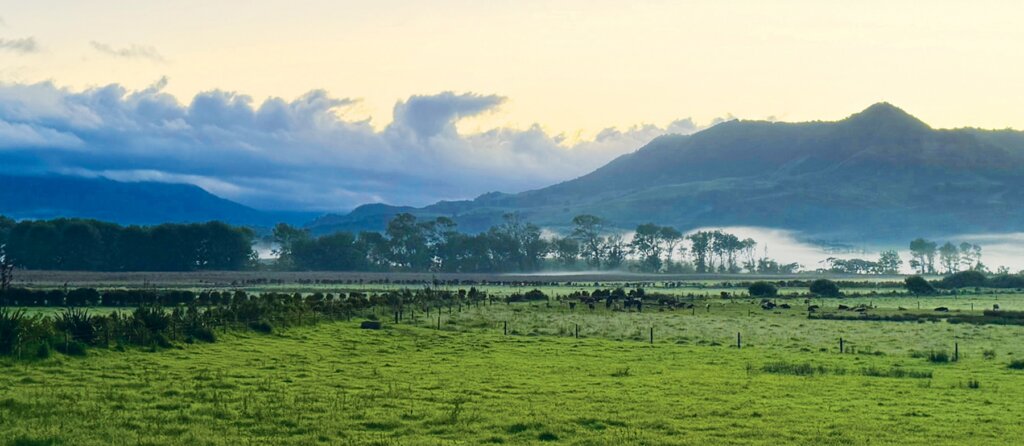
Aotearoa, the land of the long white cloud, is a land full of majestic vistas, beautiful landscapes and vibrant indigenous culture.
Photo by Kēhaulani Enos
By Christine Hitt
Last November, a group of Punahou educators embarked on the journey of a lifetime to Aotearoa, New Zealand, where they attended the prestigious World Indigenous Peoples’ Conference on Education (WIPCE) and subsequently visited Māori communities in the northern part of the country. Along the way, they learned from some of the foremost Indigenous educators in the world, returning home not only with new knowledge, but also with relationships that will have a lasting impact in the classroom.
This professional development experience was made possible through the generosity of The Marshall M. Goodsill and Herbert C. Cornuelle Endowed Fund.
WIPCE drew more than 3,000 Indigenous educators from across the globe, including Sāmoa, Canada, Asia and Hawai‘i, to share resources, knowledge and experiences in Indigenizing education. A group of Punahou educators, many of whom are involved with the Kuaihelani Learning Center and the School’s Kamaola voyaging canoe, were part of this vibrant gathering.
“It was really exciting. Everyone was very much showing their Indigenous pride,” said Starr Johnson ’98 Tuki, an Academy faculty member and Hawaiian voyaging kumu.
“It was predominantly cultural education, but not just that,” she continued, noting that artists, performances and a variety of educational programs were also part of the experience.
The group made powerful connections, not only with international experts but also with Hawai‘i educators from the Department of Education (DOE). “It was a really powerful experience,” said Ke‘alohi Reppun ’99, director of the Kuaihelani Learning Center for ‘Ike Hawai‘i, who spearheaded planning and coordination for the trip. “Beyond just the conference, this was an opportunity for our Punahou teachers to be with DOE teachers and to have conversations across that public-private divide, as well as within our own school.”
I think when our students leave Punahou, whether at graduation or earlier, they should have a foundation in ‘ike Hawai‘i.
— Sheila Worley
K – 2 faculty growth coach
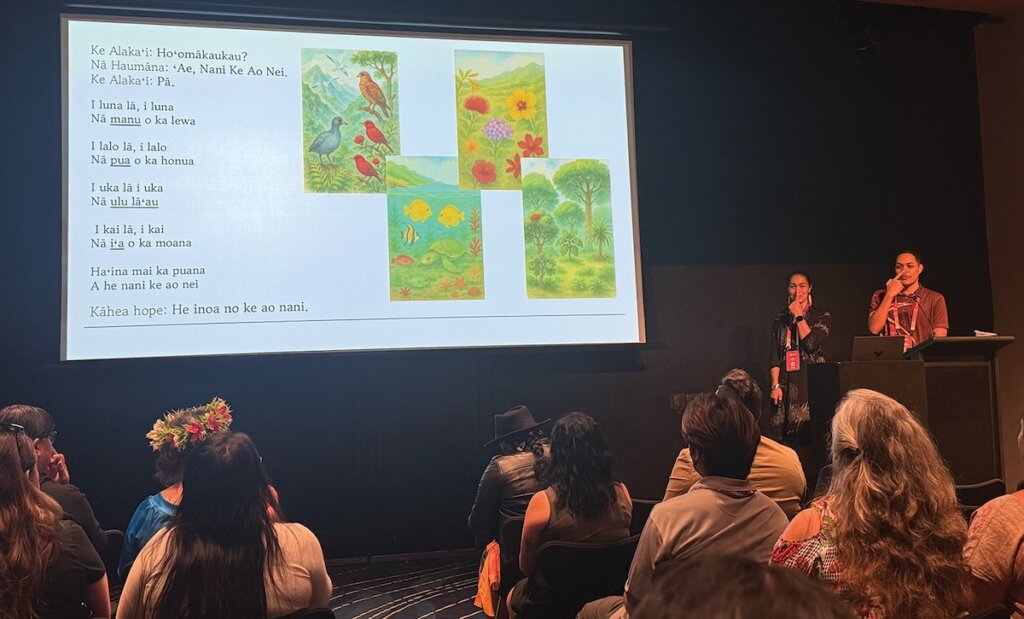
Punahou educators provided seven presentations during WIPCE. This presentation, led by faculty ‘Ānela Evans and Kainalu Mercado-Spalding, illustrates how mele is used within Punahou’s curriculum to teach ‘ōlelo to our youngest learners.
The Power of ‘Ike in the Classroom – and Beyond
For many in the group, the trip offered a chance to reflect on Punahou’s legacy and how it can continue to grow through Indigenous perspectives.
“Punahou has been such a mainstay in education in Hawai‘i for more than 180 years,” said Julia Harrison ’09, a fifth-grade math and science teacher. “But how can we continue to push the envelope and do better by our students and our place? Being able to see that from the perspective of other Indigenous cultures was really important.”
Infusing Hawaiian values in the classroom can spark meaningful growth among young learners. Cultural concepts such as kuana‘ike (perspective) and kuleana (responsibility) transcend the classroom and shape how students see their place in the world, inspiring them to care for their communities and their environment.
“I think when our students leave Punahou, whether at graduation or earlier, they should have a foundation in ‘ike Hawai‘i,” said Sheila Worley, a K – 2 faculty growth coach who attended WIPCE.
A Cross-Cultural Exchange of Knowledge
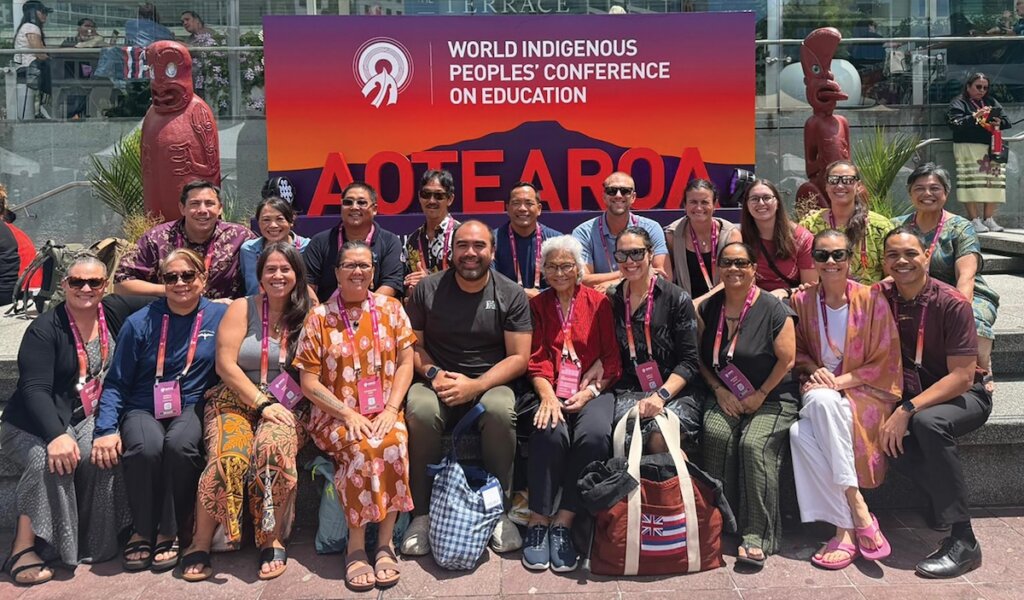
The conference was held at Auckland University of Technology and included a host of professional development and cultural experiences. Networking among indigenous people from across the globe was one of the highlights.
For the Punahou cohort, their role at the conference was one of reciprocity: they went not only to learn, but also to contribute. The team shared their work in seven presentations, ranging from prioritizing Hawaiian perspectives in Hawaiian history to teaching literacy through outdoor education. In return, they learned from others who shared real-world examples of how culture and language can be infused into curriculum across disciplines.
Reppun and Johnson Tuki were among the presenters, sharing Punahou’s new, compulsory ninth-grade Hawaiian History course, which begins with Hawaiian cosmogony rather than post-Western contact.
“I think many of the sessions emphasized relationship- building, or pilina,” said English faculty member Kaelin Tancayo-Spielvogel. Rather than framing learning as a transfer of knowledge, presenters focused on classrooms grounded in generational relationships between teachers and students.
“Even just giving a few days to build community before curriculum is particularly important,” he said, noting that it might involve students sharing who they are and where they are from. It also gives students a chance “to see themselves reflected within each other.”
The ubiquity of Indigenous language at WIPCE and in Aotearoa was another theme that resonated with the group. “The strength of their language was very powerful, because its value is visible. It’s not diminished or pushed aside. It’s right there, and it reminds you that this is the language of that place,” said Kēhaulani Enos, an ‘ike Hawai‘i faculty member at Kuaihelani.
For Emma McGuire ’93, a kumu at Kuaihelani, one session that stood out focused on how sign language can be Indigenized.
“They were sharing about place names and cultural terms used in sign language,” McGuire said. “Looking at that through a cultural lens and adapting it so it reflects their culture helps ensure those stories are not lost and their meanings are preserved.”
Huliau: A Turning Point
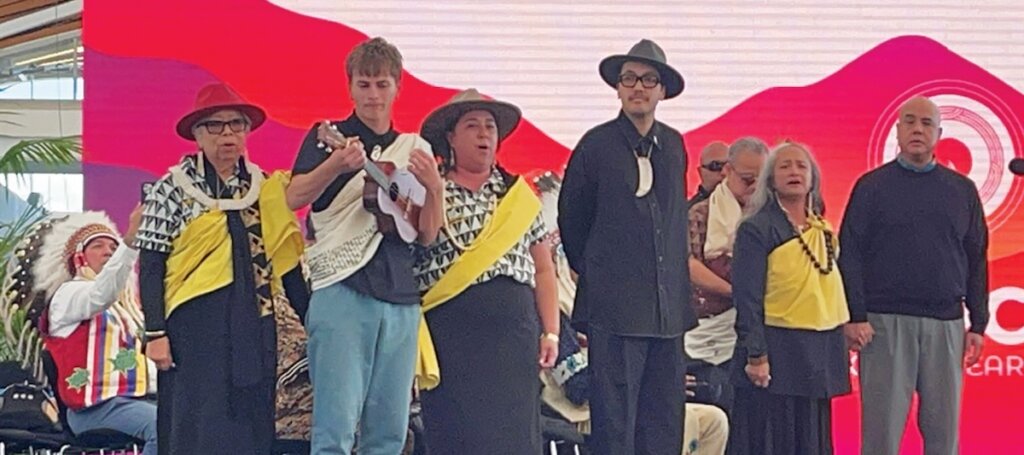
UH Hilo Hawaiian language college professor Hiapo Perreira was chosen to be the only visiting speaker at the pōwhiri, the opening ceremony, of the conference. He was joined on stage by Hawaiian members of the WIPCE delegation to lead the cohort of Hawai‘i’s attendees in the joyous and resonant signing of Ka Na‘i Aupuni.
After the conference, the group traveled to the northernmost tip of the country, visiting sacred places and immersing themselves in Māori culture. They stayed at three marae (communal meeting spaces), participated in traditional protocols and met with renowned waka captains and navigators – experiences that were deeply meaningful.
Tancayo-Spielvogel also described this portion of the trip as impactful. “It was amazing to see how strong and interconnected a marae community can be – how they support one another and carry responsibility together for future generations.”
The experiences down North (a storied Māori reference to the region) ranged from visiting ancient kauri trees in Ta-maki Makaurau to Te Rerenga Wairua, the place where departed souls leap off into the afterlife, where they witnessed the meeting of two seas, and to performances by the children of Te Whānau Mānihera, who shared mo‘olelo through song, movement, games and storytelling.
The relationships formed during the trip continue to grow. In December, the high school kapa haka group of Ngā Puna o Waiōrea in Auckland, visited Punahou. This school was the last community to host the Punahou group in Auckland, and they were welcomed to our campus with a moving ho‘okipa and cultural learning experiences. This re-engagment continued the exchange of ‘ike and culture sparked during the journey.
Navigating Forward

The 2,000-year-old Kauri tree that is considered the tūpuna of the forest. Greeted by Māori park guides and tangata whenua (people of the place) the group was guided through the forest, introduced to this tupuna, told mo‘olelo kahiko, and participated in protocol honoring Tāne Mahuta.
Punahou educators returned with a renewed sense of purpose and a desire to apply what they learned.
“Everything we experienced reinforced why ‘ike Hawai‘i is so important at Punahou,” said Tuki.
She recalled their time at Te Whakamaharatanga Marae, where Te Whānau Mānihera welcomed the group. In that setting, the children took on the role of teachers, guiding visitors through lessons rooted in culture. Tuki was struck by the pride they carried, which moved many in the group.
“For me, seeing the students’ deep connection to what they were teaching made me reflect,” McGuire said. “It’s easy to teach lessons without that personal connection, but when that connection is there, it changes everything.”
Tancayo-Spielvogel also reflected on how to expand ‘ike Hawai‘i beyond Kuaihelani and ‘ōlelo Hawai‘i classes, including within his own English curriculum. “I think it can exist across disciplines, even in STEM,” he said.
Harrison sees similar opportunities, from incorporating ‘ōlelo Hawai‘i phrases in the classroom to grounding scientific study in place through mo‘olelo.
For Enos, the experience prompted deeper reflection. “What I’ve been thinking about since returning is how we might organize and plan for teaching practices that are natural in Indigenous spaces, but that can have a broader impact on our community,” she said.
And with that sentiment, we breathe life into the possibilities for collective cultural growth at Punahou. Tihei mauri ora!