

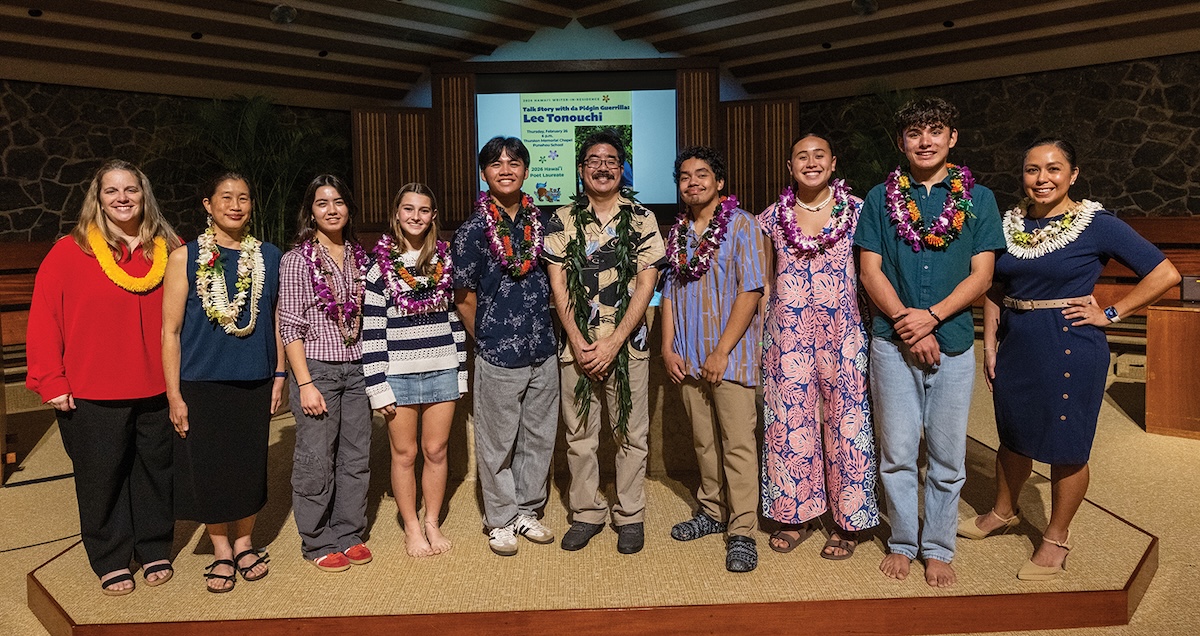

In late February, the buff ’n blue community welcomed Lee A. Tonouchi as this year’s Hawai‘i Writer-in-Residence, sparking cross-campus reflections about voice, identity and the cultural significance of language.
Known as “Da Pidgin Guerrilla,” Tonouchi has dedicated his career to affirming the legitimacy of Hawaiian Creole English, commonly known as Pidgin. Through poetry, children’s literature and theater, he challenges long-standing misconceptions about local speech while celebrating the richness of Hawai‘i’s linguistic landscape.

The Hawai‘i-born writer and editor has authored several works, including “Significant Moments in da Life of Oriental Faddah and Son,” the popular “Da Kine Dictionary,” and the children’s book “Okinawan Princess: Da Legend of Hajichi Tattoos.” His recent work includes editing the Hawai‘i Okinawan anthology “Chiburu,” performing in “The Moth at Hawai‘i Theatre” and adapting “Two Nails, One Love” for the stage at Kumu Kahua Theatre.
On February 6, just before the residency, he was named the 2026 – 2029 Hawai‘i Poet Laureate, a statewide honor recognizing a writer’s literary achievement and service to the community. In this role, Tonouchi serves as an ambassador for poetry across the islands, promoting public engagement with literature and elevating local voices.
Exploring Language and Identity
During the six-day residency, Tonouchi engaged with learners across multiple grades.
In the Academy English sessions, he opened with a poem about schools and students, inviting reflection on belonging and self-expression. He spoke candidly about discrimination faced by Pidgin speakers and shared a personal story about receiving a handwritten note from a stranger criticizing both him and the language.
“At first I wuz kinda hurt,” he admitted. “But den I thought – eh das means da guy actually read my book!”
One of the biggest misconceptions, he explained, is that Pidgin is not a real language. “Pidgin stay its own language,” he said. “Pidgin get its own grammar. Pidgin get its own rules. Pidgin no stay broken English.”
Sharing poems from “Oriental Faddah and Son,” Tonouchi traced the evolving relationship between father and son, exploring generational expectations, cultural identity and loss. In reciting “Hard Work,” he demonstrated his gift for capturing voice, whether that of a stoic father or a remembered grandfather.
“Every character get one voice,” he told students. “If you listen carefully enough, you can capture ’em.”
Students then applied that lesson themselves, crafting short monologues from perspectives unlike their own – across generations, regions and cultures – reinforcing Tonouchi’s message that voice is both personal and powerful.

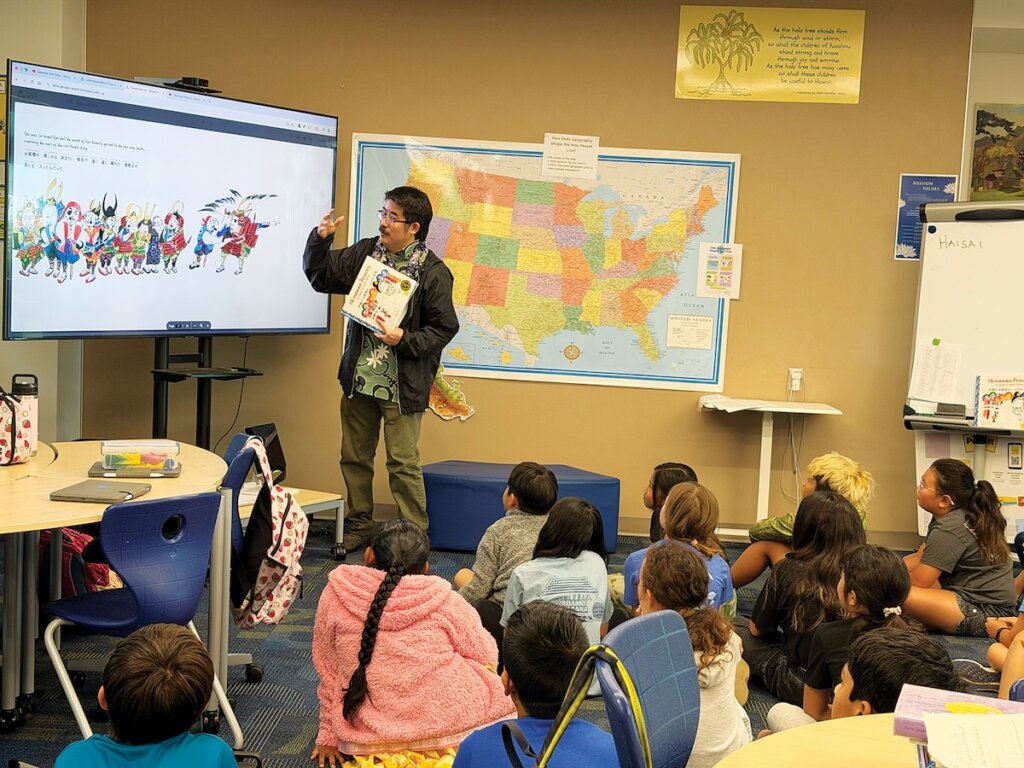
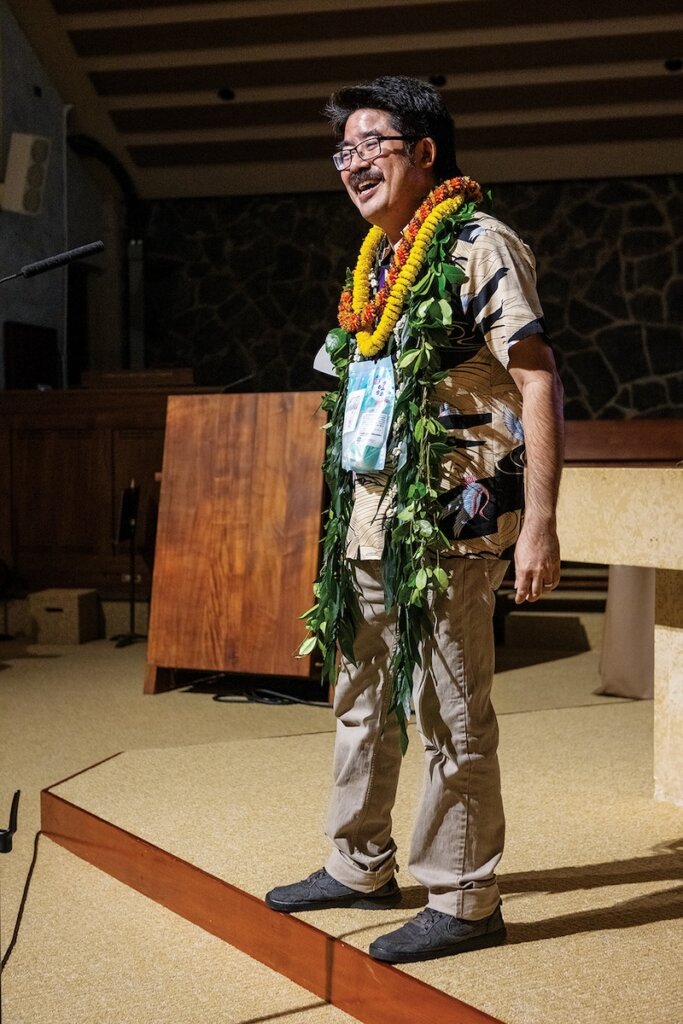
Punahou’s Hawai‘i Writer-in-Residence Lee Tonouchi participated in a host of events during his residency at Punahou, including visiting with students across campus and an evening performance in Thurston Memorial Chapel.
Honoring Heritage
Tonouchi also spoke openly about his identity as Okinawan. As a child, he once felt embarrassed by his heritage and distanced himself from the language and traditions of his grandparents’ generation.
“When I wuz young, I nevah like anyting for do with Okinawan culture,” he shared. “Now that I older, I realize how important it is for keep ’em alive.”
Today, he sees his work as part of a broader effort to preserve and continue a culture and language at risk of fading. “If we no tell our stories, who going?” he said.
In visits with fourth graders, he shared memories of his Okinawan grandmother, introduced students to the sound of the sanshin and read from “Okinawan Princess: Da Legend of Hajichi.” The illustrated tale follows a grandmother who shares the legend of traditional hajichi hand tattoos after her granddaughter questions her own appearance. When an Okinawan princess is kidnapped, she must rely on her own courage to escape.
Written in Hawai‘i Creole and translated into Japanese and the endangered Okinawan language of Uchinaaguchi, the book supports efforts to preserve Okinawan language and culture.
The session concluded with an interactive Pidgin word game. Students selected local terms – such as “grine,” “buggah,” “bafe” and “small kid time” – created their own definitions and used the words in sentences before sharing with the class. The activity sparked laughter while reinforcing Tonouchi’s broader point.
“No be afraid of getting ’em wrong,” he encouraged them. “Language belongs to da people who speak ’em.”
The residency concluded with “Talk Story with da Pidgin Guerrilla: Lee Tonouchi,” an evening performance held Thursday, Feb. 26, in Thurston Memorial Chapel. The public event brought together students, families and community members to celebrate local storytelling and the voices cultivated throughout the week.
Throughout his time on campus, Tonouchi emphasized a consistent message: write authentically, honor where you come from and claim your voice. In doing so, he reminded students that local language and cultural heritage are not something to overcome – they are something to sustain and celebrate.
Punahou’s residency program is now in its fourth consecutive year. It is made possible by the Wing Tek Lum ’64 Endowed Fund for the Hawai‘i Writer-in-Residence Program at Punahou School.