

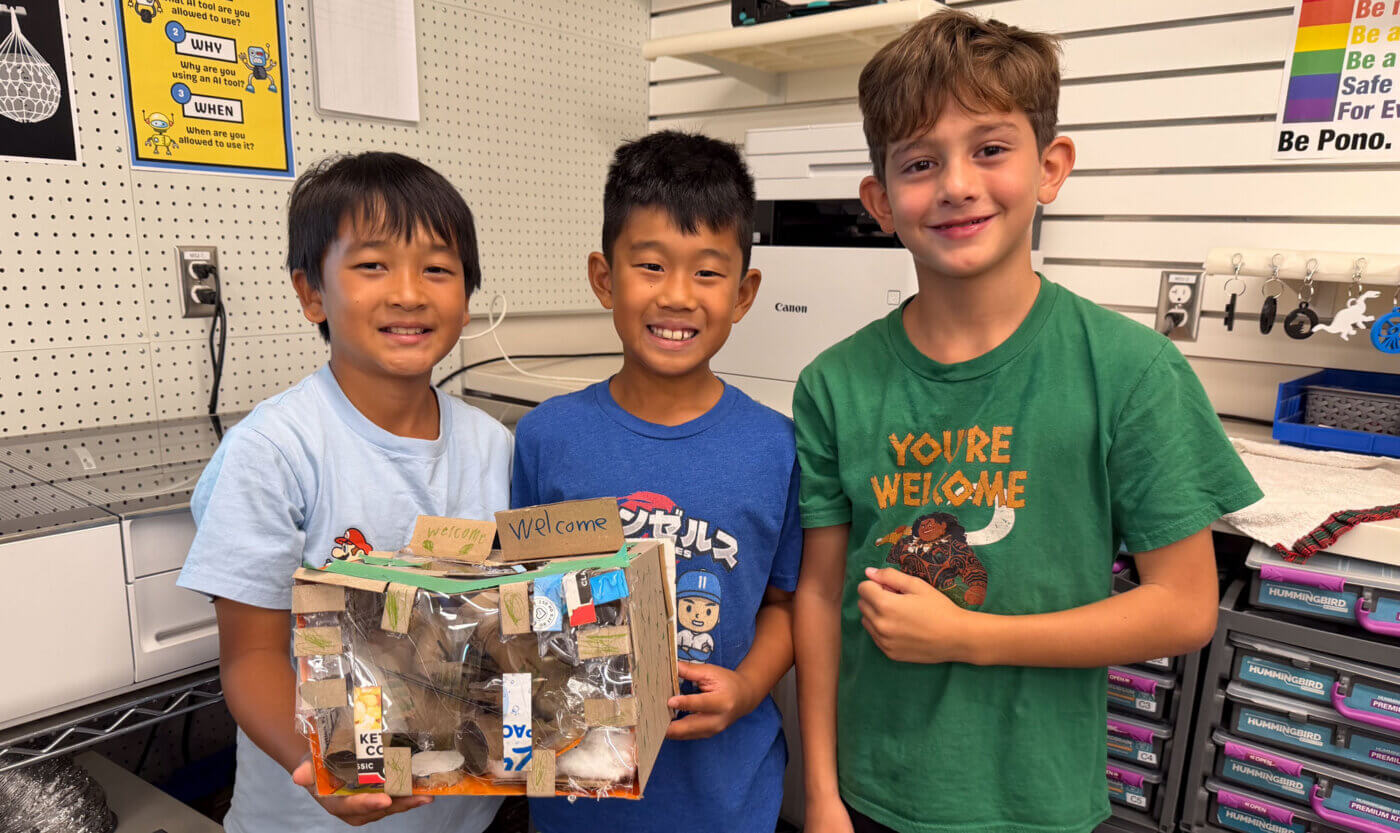
Third grade students in Danette Kobayashi’s Design Technology and Engineering class are putting engineering concepts into practice through a hands-on design challenge focused on a familiar campus visitor: geckos.
Students began by exploring gears and pulleys using LEGO sets, learning how gears mesh, how gear ratios affect movement and how crown gears can change the direction of motion. Working in small groups, they built and tested different mechanisms while considering how engineers use them to solve problems.
They then applied the Stanford d.school design thinking process – empathize, define, ideate, prototype and test – to the challenge of designing a device for geckos. Students researched geckos, identified the problem they wanted to address and brainstormed solutions before sketching their designs. Their devices had to meet several specifications, including minimum dimensions, multiple cardboard attachment techniques and, importantly, a design that would not harm the geckos.
With plans in hand, students moved into fabrication, constructing their prototypes from cardboard and incorporating LEGO components into their designs. After reviewing safety procedures, they used tools including Moto-Saws and hot glue guns to cut, assemble and refine their creations.
The project brings together research, collaboration and hands-on building, giving students an opportunity to take an everyday problem through the engineering design process from question to prototype.


