

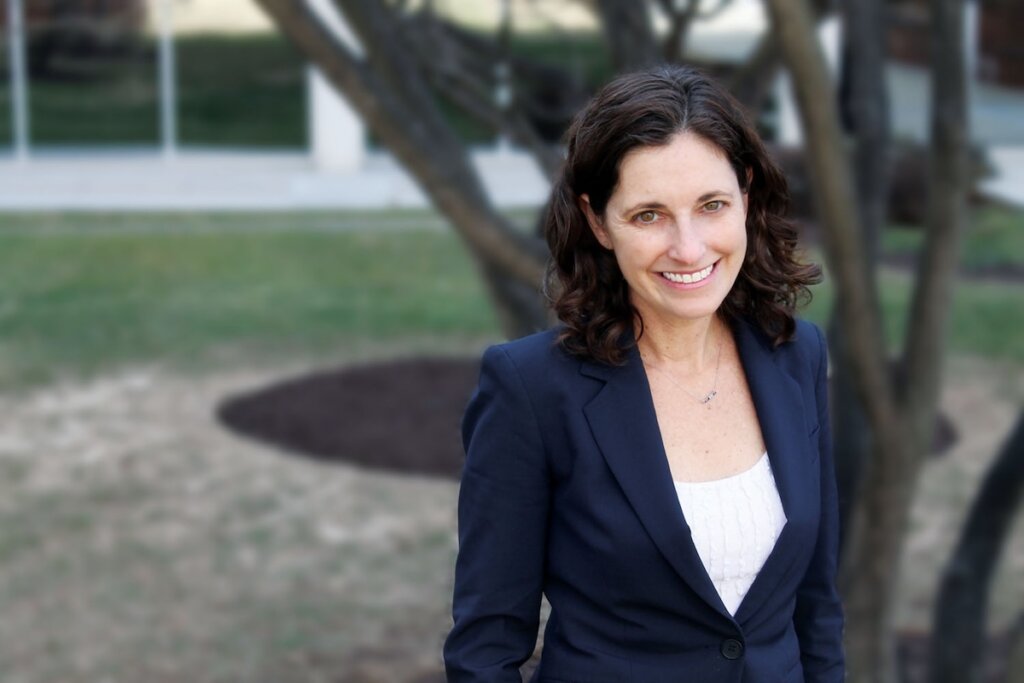
Photo courtesy of Brady
Turning Tragedy Into Action
by Robert Gelber ’92
When Erin Davis ’99 sits with families who have lost loved ones to gun violence, she is often struck by their courage. In the midst of unimaginable grief, they choose to step forward, not for recognition or financial gain, but to help prevent another family from experiencing the same loss.
“They take the worst tragedy that has ever happened to them … and they say, ‘We want to turn this tragedy into action,’” Davis said. “They’re doing it to make sure that somebody else’s child is not shot and killed.”
That sense of purpose guides Davis in her work as senior counsel and director of litigation for Brady, one of the nation’s leading organizations working to prevent gun violence. Based in Washington, D.C., she leads impact-driven lawsuits on behalf of victims and families, often looking beyond the person who pulled the trigger to examine whether members of the gun industry played a role in allowing firearms to reach people who should not have had them.
“Our goal is to get justice for our wonderful clients who were unnecessarily injured or killed,” she said, “but also to reform the gun industry through impact-driven litigation and make the country a safer place.”
For Davis, the belief that one person can make a difference began long before she entered a courtroom. Growing up in Honolulu, she remembers dinner-table conversations with her parents, Mark and Janie Davis, about current events, politics and the responsibilities that come with having a voice. Years later, they would help carry that commitment forward through Punahou’s Davis Democracy Initiative, which they helped establish to encourage students to engage thoughtfully with civic life and democratic principles. At Punahou, Davis found a community and education that encouraged her to think critically, speak clearly and act with purpose.
One of her most memorable experiences came in seventh grade, when she participated in the Damon Speech Contest. Her speech focused on the first woman to integrate The Citadel and the legal struggle surrounding that effort. Researching the story, then presenting it before classmates and eventually her grade level, was both intimidating and exhilarating.
“It was one of the first times that I got up in front of that many people and spoke,” Davis recalled. The experience showed her “how you can do hard things and creative things and really make a difference, not only in your own life, but also in the lives of generations to come after you.”
As a Punahou student, Davis also became involved in environmental advocacy, including youth leadership work around protecting Hawai‘i’s natural resources. She helped organize students, call attention to local issues and engage with public officials. It was an early lesson in civic action, and in the power of young people to contribute meaningfully to issues larger than themselves.
After Punahou, Davis studied public policy at Duke University, then earned her law degree from Temple University’s Beasley School of Law. She began her legal career as a public defender, representing individuals while upholding broader principles of fairness and access to justice. Later, she moved into civil practice, representing people who had been injured and seeking both accountability and reform. She also served in the U.S. Department of Labor during the Obama administration, working on health and safety issues affecting miners.
The throughline, Davis said, has always been the same: using law and policy to protect people and improve systems.
Although gun violence is often treated as a divisive issue, Davis is quick to emphasize that Brady’s work is based on common ground. The organization’s color is purple, a blend of red and blue, reflecting its belief that safety is not a partisan value.
“There is a tremendous amount of commonality between gun owners and non-gun owners,” Davis said. “Every gun owner wants guns to be sold in safe and lawful ways, as do non-gun owners.”
That ability to listen across differences and understand multiple perspectives is something Davis connects to both Hawai‘i and Punahou. Growing up here, she said, taught her that how people engage with one another matters as much as what they are trying to accomplish.
“It’s not just what you do,” she said. “It’s how you do it.”
Now living in the Washington, D.C., area with her husband and two children, Davis still finds renewal outdoors, especially when she returns home to Hawai‘i. She loves the ocean, hiking and the sense of aloha that shaped her earliest understanding of community.
Her advice to Punahou students is simple: “Go for it.” Learn as much as you can. Listen carefully. Understand different points of view. Then take the opportunity to act.
For Davis, that belief began at home, grew at Punahou and continues through work that is difficult, demanding and deeply worthwhile: helping others turn tragedy into action, and using her voice to help make the world safer for those who come next.