


A Human-Centered Approach to AI
by President Mike Latham ’86
The history of Artificial intelligence (AI) stretches back nearly a century. As early as the mid-1930s, the British logician Alan Turing envisioned a computer that would develop the capacity to scan vast amounts of information, guided by a program stored in its memory. Most crucially, Turing posited that such a machine could use what it scanned to improve its own guidance and continually learn in the process, expanding the range of tasks it might accomplish.
In subsequent decades, the development of increasingly powerful processing systems, the design of neural networks, and the creation of dedicated programming languages enabled rapid innovations toward what came to be known as generative artificial intelligence. By late 2022, the release of ChatGPT brought AI to millions of consumers in a form that could be accessed by virtually any personal computer.
Suddenly, a powerful technology that studies patterns and learns from examples to swiftly create new text, images, models, or music became widely available. As new platforms and systems like Gemini, Claude and Perplexity joined the marketplace, their potential to improve efficiency, synthesize information and enhance creativity seemed limitless.
Almost as rapidly, however, AI became the subject of an intense debate about its likely impact on human society. While almost all commentators agreed AI would transform higher education and the workplace, analysts became deeply divided about the direction of change itself.

Proponents envisioned a future of rapid technological advances, immense economic growth, and the potential to improve human life through sweeping improvements in medicine, transportation and personalized learning. Critics, however, warned that AI tools reproduce systemic biases in the data sets they train on, frequently violate standards of privacy and data security, and enable the creation of “deepfake” images and audio to spread false narratives and jeopardize democracy.
Already concerned about the impact of smartphones and social media in promoting anxiety and depression among young people, critics asked whether AI might now do further damage. What happens to a lonely or introverted young child, they wondered, when an AI chatbot promises to meet the need for companionship without the work of forming meaningful human relationships? What will happen to our environment, when the enormous computing power used to drive AI technologies puts further stress on our water resources and radically amplifies our energy needs?
At Punahou, we believe that the rise of generative AI demands an intentional and thoughtful approach. As educators, we must prepare students to thrive in a world that will be transformed by AI while still maintaining our human-centered emphasis on teaching and learning. Ultimately, we need to enable our students to develop a critical literacy with respect to AI.
That requires that our teachers provide students with opportunities to engage directly with AI, that our students learn how the technology works, and that they also understand its advantages, pitfalls, and ethical implications. Above all, it requires that we determine how best to take advantage of the potential for AI to promote personalized learning while avoiding uses which threaten to undermine our key learning objectives.
Over the past year, our school’s leadership has focused on how best to navigate these challenges. In March, Punahou’s administrative leaders joined our Board of Trustees for an intensive learning experience in Silicon Valley, during which we met with scholars at Stanford University’s Project on Human-Centered AI, industry experts at Google and Apple, alumni using AI in science and business, and the leaders of other prominent independent schools. We have also consulted with educational innovators and supported outstanding Punahou faculty as they explore the use of AI tools in teaching across multiple disciplines and grade levels.
“As educators, we must prepare students to thrive in a world that will be transformed by AI while still maintaining our human-centered emphasis on teaching and learning. Ultimately, we need to enable our students to develop a critical literacy with respect to AI.”
Through this process, our Junior School Principal Todd Chow-Hoy, Academy Principal Gustavo Carrera, and I have arrived at several overarching principles which now guide our way forward. These include the following:
A Discerning Approach to AI Integration and Personalized Learning
We must use AI to promote personalized learning without jeopardizing our fundamental learning goals. This requires very careful planning about where AI might be deployed in our curriculum and pedagogy, and where it should be avoided. Because writing is so fundamentally connected to the work of critical thinking, for example, we believe that the teaching of writing must remain a high priority.
While AI tools like ChatGPT can produce impressive, well-written essays with the flick of a few keystrokes, if we were to allow them to substitute for the cognitive work of developing and delivering an effective written argument we would do our students a real disservice. As a recent MIT study has demonstrated, students that use AI to generate papers have a much weaker grasp of the ideas within them and remain far less invested in the knowledge or the arguments they contain. Teaching writing, using focused, scaffolded exercises and discussion, is essential for our students to develop the capacity for original thought and reasoning.
But AI has great potential for other educational purposes. For work in data visualization, engineering and design, modeling scientific structures, practicing mathematical problems, and conversing in foreign languages, for example, AI holds enormous promise. It can help students master content, apply principles to specific cases, and gain intensive practice with problems and tasks that lead to rapid skill building and understanding. AI tools may also help our teachers to develop adaptive tutoring systems, plan lessons and create summaries for students to use. Our students need to have strong engagement with such tools to prepare them for success in higher education as well as the future workplace.
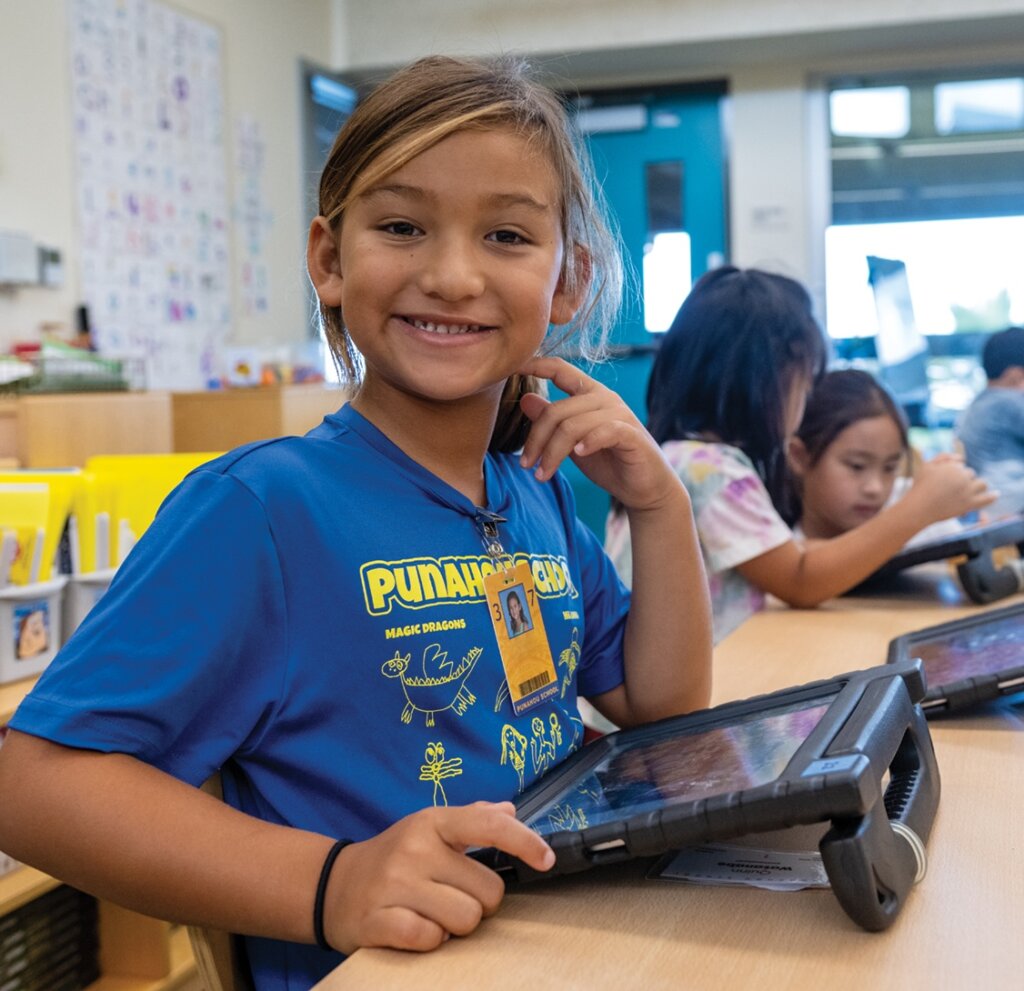
Human-Centered Teaching Based on Dialogue, Close Reading and Analysis
Amid the rapid transformations that AI will promote, we believe that our students need to develop critical thinking, problem-solving, and creativity to serve them well wherever they go and whatever they do. These fundamental, human-centered skills are best taught through a strong emphasis on class discussions, oral presentations, close reading and analysis.
If we can teach our students to articulate their ideas, learn actively, collaborate with others, grapple with ambiguity, question meaning, and form grounded interpretations in both written and verbal forms, they will develop the core capacities to navigate the future. A strong emphasis on dialogue, close reading, and analysis is not new to Punahou. Indeed, these are some of the essential hallmarks of an outstanding liberal arts education. We believe, however, that their value will only increase in a world shaped by AI, and that they will continue to serve our students well.
“If we can teach our students to articulate their ideas, learn actively, collaborate with others, grapple with ambiguity, question meaning, and form grounded interpretations in both written and verbal forms, they will develop the core capacities to navigate the future.”
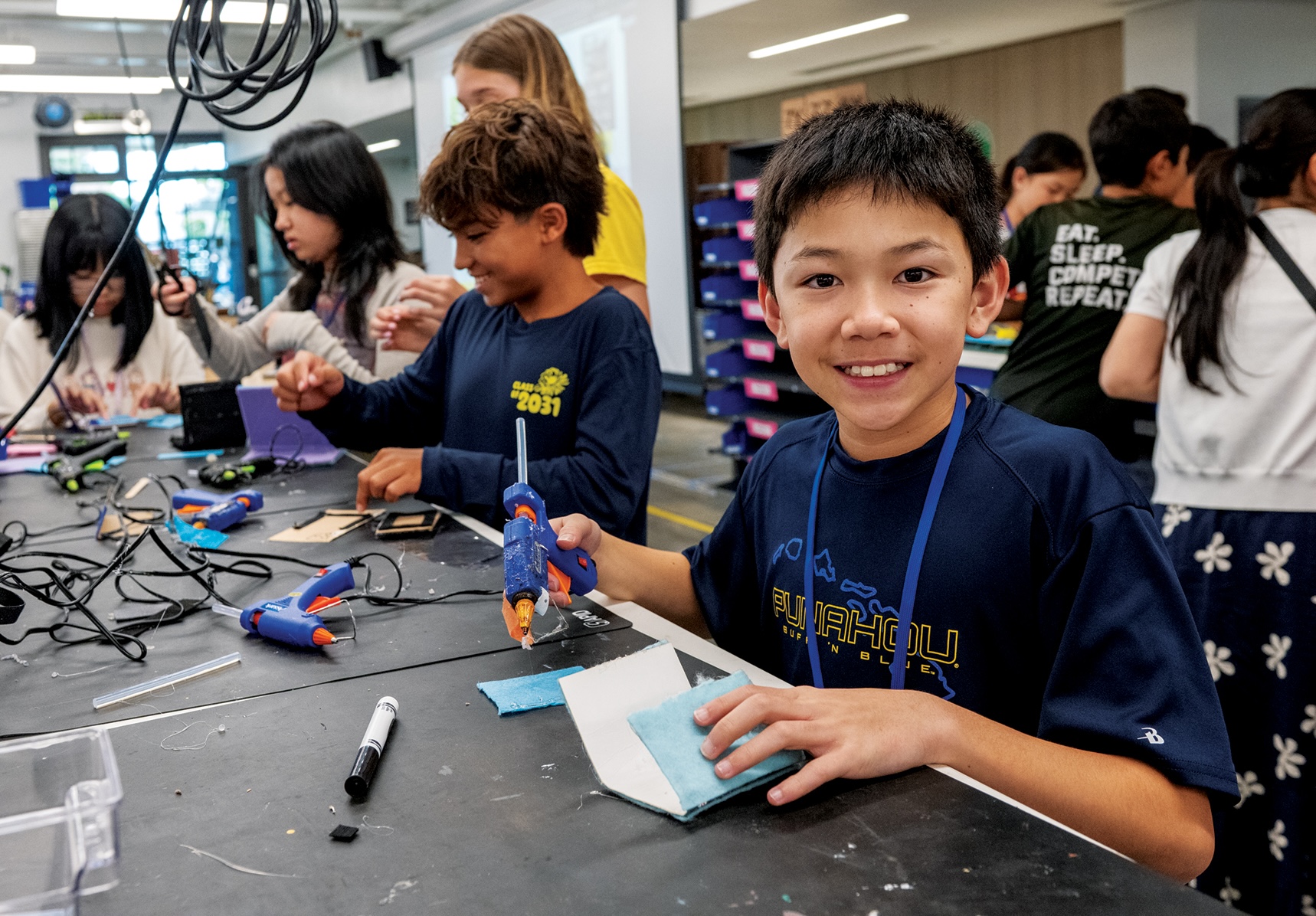
Grade 7 students fabricating projects in Nozomi Ozaki’s Design Technology and Engineering class. They used AI as a collaborative partner during the ideation stage of the (add) design process.
Innovative Student Assessment
We also believe that our methods of assessing student learning should evolve. In immediate terms, we must preserve our commitment to academic integrity. Student assignments that are vulnerable to the unauthorized use of AI should be reconsidered. Going forward, I expect that many of our teachers may rely more on in-class writing assignments instead of long papers to be drafted at home. Some may also turn toward other means to evaluate student understanding, including in-class presentations or oral examinations. More fundamentally, however, we will also develop assignments in which we expect students to make use of AI and then to think critically about how the tools either supported or detracted from their understanding. Building in a reflective dimension will help our students to become sophisticated users of AI tools, aware of both their benefits and their liabilities.
“While AI tools like ChatGPT can produce impressive, well-written essays with the flick of a few keystrokes, if we were to allow them to substitute for the cognitive work of developing and delivering an effective written argument we would do our students a real disservice.”
“For work in data visualization, engineering and design, modeling scientific structures, practicing mathematical problems, and conversing in foreign languages, for example, AI holds enormous promise.”
Wellness and Ethics
As we go forward, finally, we will need to ensure that our approach is congruent with our commitment to care for the whole student. In the past few years, we have deepened our curriculum in digital literacy in the Junior School to enable students to become more sophisticated consumers of media and to develop a stronger understanding of the personal challenges technology can create.
In Case Middle School and the Academy, our health courses contain units to enable students to consider the impact of technology on their personal well-being and what responsible use entails. I believe that the need for such instruction will only increase and that we will need to develop additional ways to engage students with the ethical dilemmas that AI will create. Beyond helping students to consider what they can do with these powerful tools, we will also need to teach them to ask what they should do with them, and why.
While the challenges that AI presents are real and pressing, I believe that Punahou is very well equipped to meet them. As the stories in this edition of the Punahou Bulletin illustrate, we are investing strongly in faculty training and growth, adapting our pedagogy, and defining our priorities thoughtfully.
We will also continue to emphasize the key elements of critical thinking, meaningful dialogue, and authentic relationships that stand at the heart of our human-centered approach to education. This will prepare our students to not only become discerning and successful users of AI tools, but also to fulfill our school’s mission to empower them “to dream and discover their purpose and kuleana to Hawai‘i and the world.”
Related Article: Prompted: Intentional AI Literacy for a New Frontier