


‘Do Not Rewrite this Paper for Me’: Ethics and AI
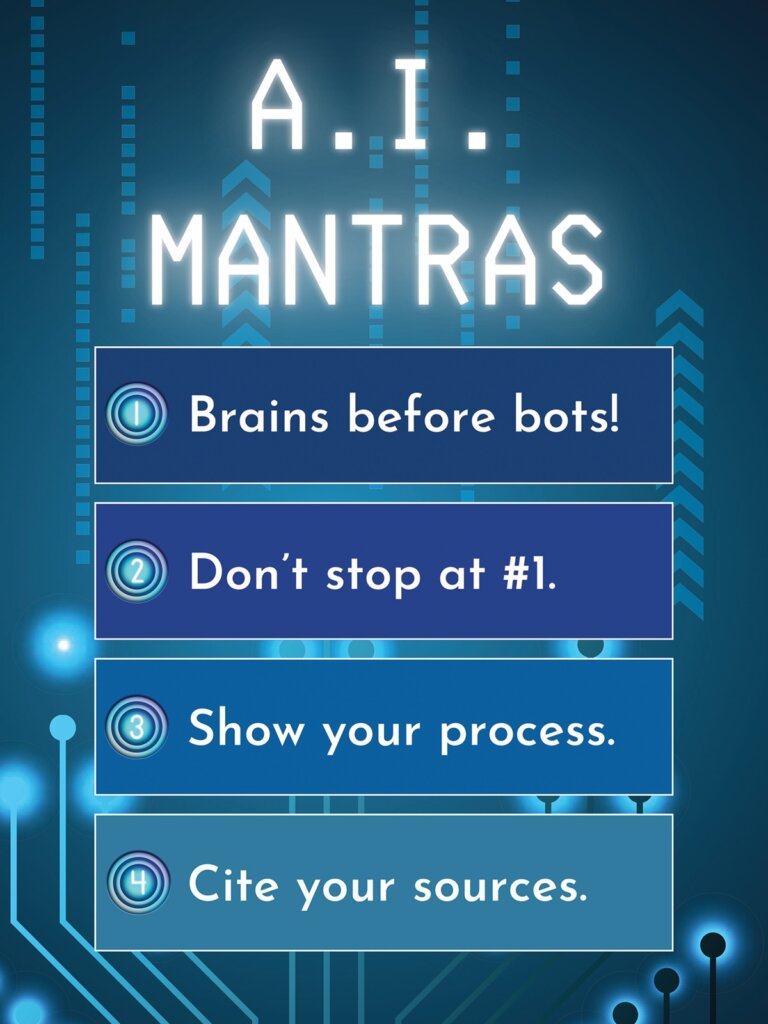
A classroom poster in Cowell’s room outlining “AI Mantras,” reminding students that human thinking must always lead the way for academic work.
by Ben Yuri Biersach ’87
Joshua Chang ’28 had carefully avoided using ChatGPT since his time in Case Middle School. When the generative artificial intelligence (AI) chatbot launched in 2022, he was a seventh grader, wary of a tool that could seemingly write an entire paper with a single prompt.
“I avoided using it,” Chang remembers. “Why would I, if I could possibly get in trouble for doing so?”
Fast forward a few years, and the landscape looks entirely different. AI tools are now woven into everyday life and, increasingly, the classroom. Just as the technology has advanced, so too has the collective understanding of how it can be used to support – rather than undermine – learning.
At Punahou, AI is now viewed as a support tool for learning, and teachers provide guidance for its ethical application. “Everyone on our faculty has a responsibility to learn about and use this new technology so we can better understand the world we are preparing our students to succeed in,” says Academy English Department Head Marisa Proctor. “It is our job to give students guardrails and allow them to practice working within those parameters – to protect themselves and each other from the risks of working with such powerful capabilities.”
To advance this goal, the School introduced a ninth-grade artificial intelligence literacy unit in all Academy English classes for the 2024 – 2025 school year. Proctor explains that the unit was designed to address several questions: “How can we open up conversations between students and teachers about AI? How can we use AI to support students’ growth as writers and critical thinkers? What does ethical, responsible, and appropriate use of AI in the English classroom look like?”
“It is our job to give students guardrails and allow them to practice working within those parameters – to protect themselves and each other from the risks of working with such powerful capabilities.”
– Marisa Proctor, Academy English Department Head
A team of English 1 teachers met during the summer of 2024 to establish guidelines for appropriate use of the technology. Students practice prompting AI to ask questions that stimulate their thinking and aid revisions to early drafts. Teachers guide them to avoid using the bot for idea generation or composition of content. Instead, students are instructed to tell the bot, “Do not rewrite the paper for me.” They are also required to share a chat log of their interactions with the bot.
As part of the first cohort to take the new AI literacy unit, Chang was enrolled in Lara Mui ’88 Cowell’s ninth grade English 1AB class and was assigned to use AI while writing a summative assessment on the theme “Who Am I?” He decided to write a vignette about his family, and by the time he was ready to bring AI into the process, he had finished his first draft. “I asked the bot to give me feedback based on the assignment’s criteria and not to rewrite the vignette,” he explained. “At the bottom of my paper, I included a link to the actual chat so my teacher could see what I asked, how I asked it, and what feedback was given. We had to be transparent about what we did.”
Chang’s experience with AI changed his perspective on its usefulness. He has already used it to solicit feedback on a recent social studies paper and plans to continue using the tool for future assignments as he progresses through the Academy.

The partnership between students and teachers is more vital than ever, as they explore the new AI frontier. At Punahou, there is always dialogue and clear guidance to ensure this new technology is being used responsibly. Above: Joshua Chang ’28 with Punahou English Faculty Lara Mui ’88 Cowell.
Proctor says Chang’s comfort with applying the technology ethically is typical. “The vast majority of students want to learn and do the right thing. But they need guidance and support – as with any new skill.”
She adds that the teacher-student relationship is more important than ever. “We have to focus on building trust with our students, creating learning environments where they feel safe to practice, ask questions, and revise their work, and keep lines of communications open,” she says. “In short, we have to give our students opportunities to intentionally practice academic integrity – that is, to produce original work that accurately conveys what they know and can do.”
Proctor is also excited about the potential for generative artificial intelligence technologies to increase equity among different types of learners. “Proofreading apps like Grammarly can support students with dyslexia and dysgraphia in communicating their ideas clearly and gracefully – when, just a decade ago, their ideas may not have even been considered because of typos that reveal more about their brain’s wiring than their actual intelligence.”
As a new class of ninth graders arrives at the Academy in fall 2025 and prepares to take the AI literacy unit, it’s clear their future interactions with this powerfully disruptive technology will be informed. These students – and the faculty guiding them – have embraced the responsibility for using generative AI in productive and ethical ways.
“AI is another pathway some students can use to support their thinking — and there’s a way to do that without having it do the thinking for them,” Proctor says. “That really is our job as teachers: to help students bring out their voices and tell their stories in a way that’s authentic to who they are.”
Main Article: Prompted: Intentional AI Literacy for a New Frontier