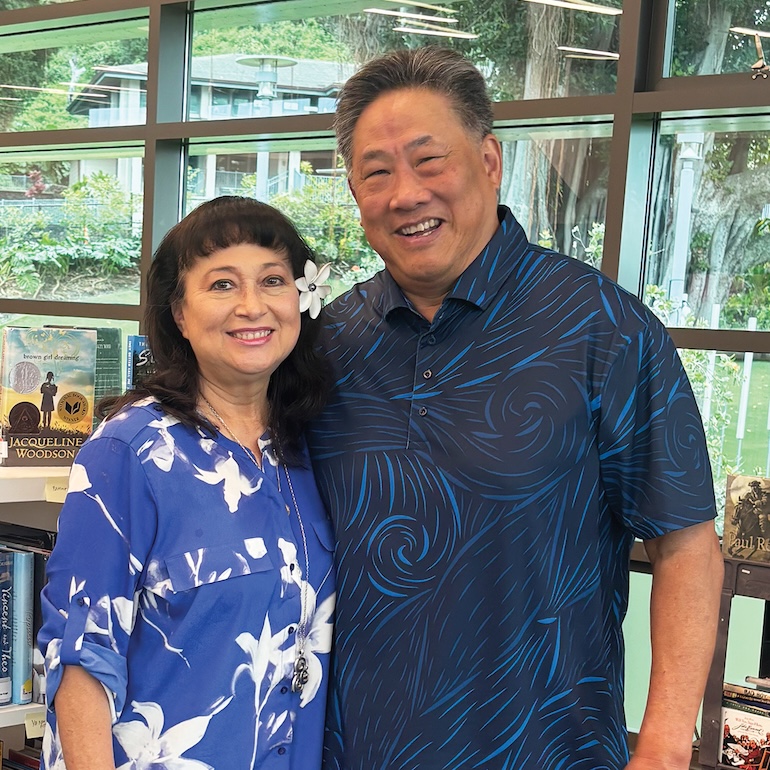

In a League of Their Own
Collectively, Sharon Vincent-Lum ’80 and Alan Lum ’80 have dedicated more than 81 years to teaching at Punahou. Sharon began her journey in 1985; Alan joined a year later. Though their paths have been distinct, with Sharon focusing on fifth grade and Alan primarily teaching second grade, both careers have been marked by bright milestones.
One such moment came in 2002, when Sharon traveled to Washington, D.C., to receive a national award for Most Inspirational Teacher. The honor was especially meaningful because it stemmed from a nomination by her former student, Kara Furmark ’02, who was named a Presidential Scholar that year. Another lasting highlight came when lines from a poem by one of her students, Alaia Kinzer ’30, were selected for the opening of Punahou’s new mission statement in 2023.
For his part, Alan’s tenure is defined by the steady cultivation of generations of students, more than 2,000 and counting. But his influence extends well beyond the classroom. He has been a dedicated coach in boys and girls’ basketball and girls’ water polo, and for more than two decades has served as dean of students for the Clarence T.C. Ching Partnerships in Unlimited Educational Opportunities (PUEO) program.
These milestones speak to the enduring reach of their work and reflect a shared commitment to shaping the lives of young learners. Married for 39 years, Sharon and Alan also experienced the school as parents, watching their children, Jade ’12 and Jared ’16, complete K – 12 at Punahou. Today, both are thriving in their respective careers. Jade is teaching and completing her doctorate in English at the University of Hawai‘i at Mānoa, while Jared, who lives in New Jersey and travels extensively for his work in the insurance industry, is planning to marry this summer.
Together, their careers reflect not only a shared dedication to education, but a life shaped by service, community, and a deep belief in the potential of every student.
Their announcement this spring of a well-deserved retirement from Punahou marks the close of an era. Their presence and dedication will be deeply missed by colleagues, students and families.
Sharon Vincent-Lum ’80
You are a proud buff ‘n blue alumna. Did you think you would return to Punahou after graduation?
When I first committed to becoming an educator, I knew my deep love for Punahou would propel me to return, and I have cherished every moment. I was proud of the school’s commitment to education and recognized the exceptional learning experience it provided me as a student. I was fortunate to have amazing teachers who taught me so much, including Doc Berry, Peter A. Powlison ’40, William “Bill” George Messer and Jacques Leokane Pryor. Because I valued that education so greatly, I knew I would love to return and give back to the school that gave me so much.
During your tenure at Punahou, you have always taught grade five. Did you ever want to switch gears?
I had the opportunity to move to grade six at one point, but I love grade five so much that I stayed. The students are eager to learn, and seeing their growth is incredibly rewarding. When I started, I worked with the mavens of our grade level, Jane Tottori and Pat Martin. I will always be grateful to them.
There has never been a dull moment for me. I helped to start the drama club, coached cheerleading, and served as grade-level chair and curricular chair. I was also on the K – 5 writing committee, the K – 8 social studies committee, and I worked with others to write curriculum for the grade level. Additionally, being on various committees allowed me to connect with many people in different divisions and grade levels, which I considered a great opportunity.
There is so much buzz about AI in education. How is technology changing the landscape?
Technology has changed dramatically over the years, which is powerful. But the key principle I like to emphasize in my classes is that each child possesses inherent creativity. Regardless of the technology used, a student’s creativity must be prioritized. When using AI, we must provide students with structure and guidance. This ensures students use technology to their benefit while maintaining a strong sense of ownership over their creative work.
In 1985, you helped to start Punahou’s 5th grade drama club. What was that like?
Norm Cox was my supervisor when I arrived, and I credit him with encouraging us to bring drama and theater opportunities to our students. That year, Terry Woody (a wonderful colleague who was also new) and I started the club together. We had 40 students that first year, and they performed in MacNeil Auditorium. I watched the club grow to include up to 120 students in my last year as director. Being on stage is so important because it harnesses the students’ superpowers, particularly the confidence that grows in children when given the opportunity to express themselves.
Creativity seems to be a common thread in your classroom. Why?
Creativity is essential to my teaching because I believe every person possesses it, even if they do not always recognize the power that they hold. I often begin with poetry because it allows students to express emotion and explore language in meaningful ways. We talk about “delicious language” and what makes words come alive. Providing opportunities for students to speak, perform, and collaborate helps them find their voice and develop confidence, both in the classroom and beyond.
What have you learned about yourself during four decades of being a teacher?
I have certainly loved this journey. I feel blessed by all the opportunities I have had and for the people I have worked with, the students and their families. Now, I am teaching the children of former students, which is wonderful to see.
Alan Lum ’80
Your mother was a renowned math teacher at Lincoln Elementary School. Did you aspire going into education?
No, I originally wanted to be a farmer because I love to see things grow. In many ways, teaching is similar. We plant seeds and, over time, we watch them grow. You may not see the results immediately, but they emerge later. It is both humbling and a blessing.
You taught third grade for 10 years before moving to second grade, where you have been for 30 years. What is so special about this age?
Second grade is a time of important transitions. Students begin to read in earnest and learn more about themselves and the world around them. Much of the second-grade experience is social, focusing on learning how to interact and be a functional part of a group.
Witnessing that growth is incredibly rewarding. This development spans physical, cognitive, social and emotional areas. The seeds planted during this year take root, and with patience, students reach important milestones.
There have been so many changes in teaching over the last four decades. What has remained a constant for you?
Emotional intelligence, not artificial intelligence, will remain the guiding force for educators. Programs and curriculum will continue to evolve, but what stays constant is the love for students and the school, and the partnerships with parents.
Our focus must be child-centered. The academic domain is important, but the emotional domain is just as critical. Students cannot learn effectively if they do not feel good about themselves. When students struggle, it is often not due to a lack of capability, but to self-doubt. Confidence is essential. When students feel secure, they tend to thrive in every area.
You have been involved in sports your entire life, particularly basketball. How do you bring that experience into your classroom?
I coached boys and girls basketball from the intermediate level through varsity. Later, I transitioned to coaching water polo with Ken Smith, who became a mentor in coaching and in life. His philosophy was always “mind, body and spirit,” which I try to bring into my teaching. I view sports as a powerful way to work with students. While everyone wants to win, there are often setbacks, and those moments offer valuable lessons. The analogy of the court and classroom applies here: dedication, resilience, and effort matter in both places.
What drives your passion for PUEO?
I am a big believer in paying it forward. I grew up in Kalihi, where I played sports with many public school students. I was fortunate to attend Punahou, an opportunity not everyone had. Given my experience, I want PUEO to serve as a support system, giving these students a similar opportunity.
The program’s success is rooted in trust. When students leave their home communities to come to Punahou, they are often skeptical. However, once they and their families trust the PUEO program and understand its benefits, they become fully committed. Building trust is essential for community building. PUEO is a clear example of how Punahou can be a private institution with a public purpose, and that feels really good.
You are a big believer in mentorship, whether in the classroom or in the sports field. Who has helped your journey at Punahou?
Malia Ane ’72 took me under her wing and essentially guided me through that first year, showing me the ropes. From there, Hattie Eldredge ’66 Phillips, who was in first grade, moved up to third, and we all loved working together. Malia and Hattie provided the foundation for me. Coach Pal Eldredge ’64 was another key influence. He had been my football coach and later guided me in coaching, shaping both my approach to athletics and my work with students.
For a complete look at their extraordinary journey and impact on the School, please see the Aloha Ceremony article.