

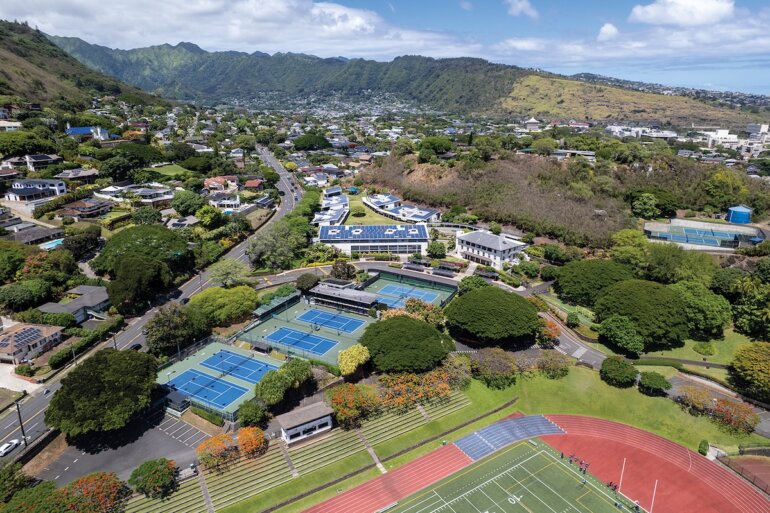
Outstanding tennis facilities like the Dillingham Tennis Complex help us to grow the game at the grassroots level, and we are proud to recognize them for their ongoing impact on the sport of tennis.
Theodore Loehrke
USTA’s Managing Director of Section Partnerships
By Ben Yuri Biersach ’87
On a late August day in 2025, luminaries of the tennis world converged on Queens, New York, for the second round of the U.S. Open Championships. As top players like Aryna Sabalenka and Novak Djokovic battled on court, Punahou School was celebrating a victory of its own: receiving an Outstanding Facility Award from the United States Tennis Association (USTA), which recognized the Dillingham Tennis Complex as one of the finest in the country, alongside facilities at universities such as Princeton and Temple.
Punahou Director of Tennis Ikaika Jobe ‘01 and Associate Principal for K – 12 Student Life James Kakos were present to accept the award on behalf of the School.
“Outstanding tennis facilities like the Dillingham Tennis Complex help us to grow the game at the grassroots level, and we are proud to recognize them for their ongoing impact on the sport of tennis,” said Theodore Loehrke, the USTA’s Managing Director of Section Partnerships. He added that Punahou “continues to support (the USTA’s) shared mission of growing tennis to inspire healthier people and communities everywhere.”

We wanted to build the preeminent tennis facility in the Pacific and serve not only our own students and student-athletes, but also the greater community.
James Kakos
Associate Principal for K – 12 Student Life
The Building Blocks of a Top-Notch Complex
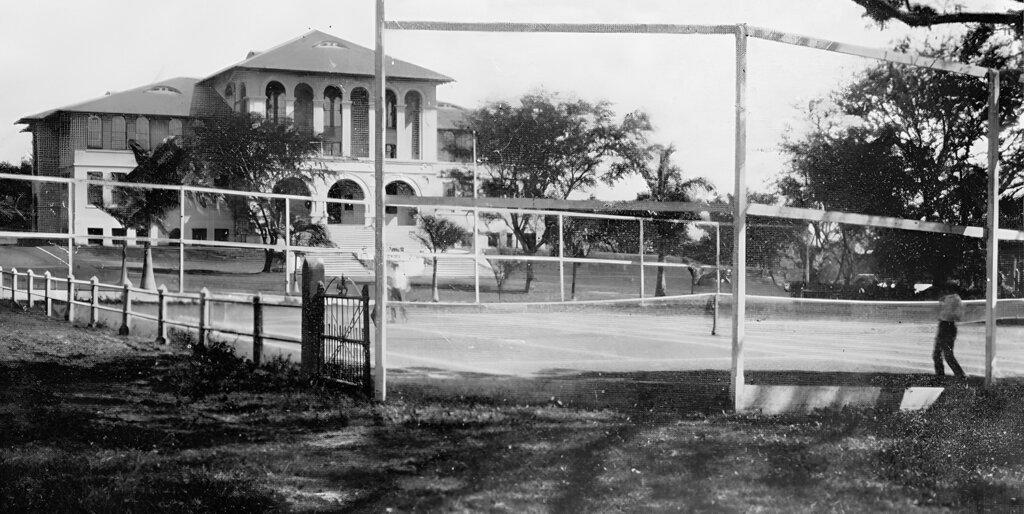
For nearly as long as tennis has been played in the Hawaiian Islands, there has been a tennis court at Punahou. One of the first courts in the state, located adjacent to Old School Hall, appears in archival photos from the late 1800s. Even then, its presence reflected the importance of physical education and spirited recreation in the lives of O‘ahu College students.
Since that time, tennis has remained an integral part of Punahou’s athletics program, and high-quality facilities have been foundational to the sport’s success for the Buff ’n Blue. The long-term vision guiding the School’s investment in its tennis facilities has resulted in a complex that today rivals those found at many large universities.
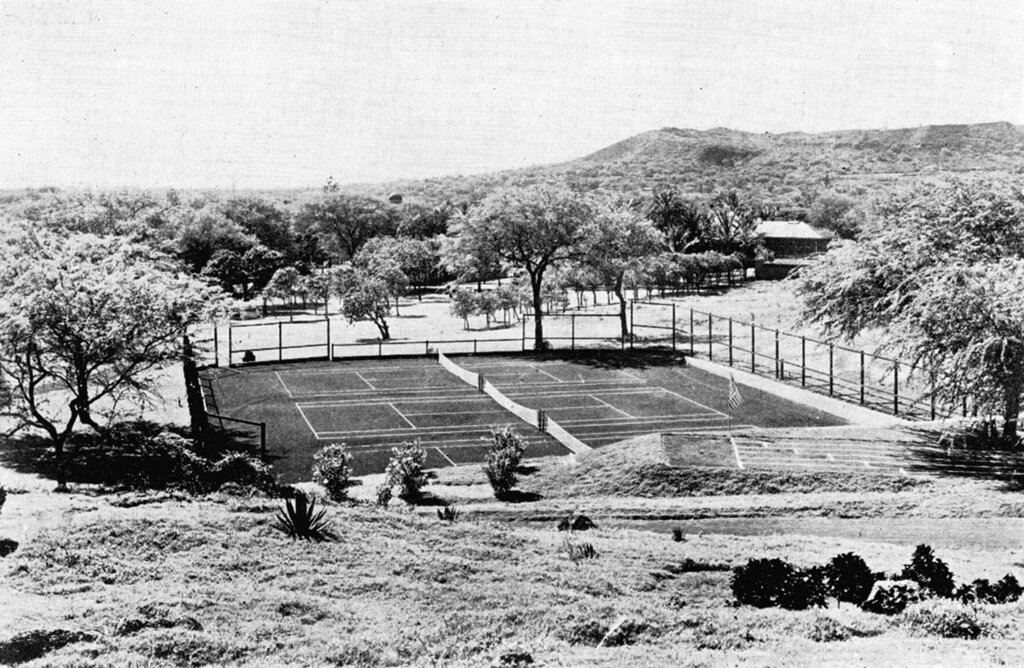
The Dillingham Tennis Complex (originally dedicated in 1950) began taking its current form in 2009 through a four-year restoration project envisioned by then-Director of Tennis Bernard Gusman and supported by the fundraising efforts of trustees Kathleen Sullivan ’75 Wo and Ethan Abbott ’72.
In 2013, a significantly expanded Tennis Building was unveiled. The original structure was doubled in size with the addition of a second floor, allowing the program to better accommodate daytime PE classes, after-school players, competitive student-athletes as well as the staff who support them.
That same year, new lighting was installed and the courts were resurfaced. For longtime tennis programs coordinator Lenora Lee, who has witnessed nearly three decades of the facility’s evolution, the lights were transformative.
“With our ILH league matches, every time darkness fell we had to stop the match and figure out how we were going to finish,” Lee explains. “With the introduction of the lights, we could play until 8:30 p.m. We no longer had to reschedule incomplete matches for another day.”
Later in 2013, the USTA Hawaii Pacific Section honored Punahou with a Tennis Facility of the Year Award, recognizing both the quality of the Complex and the program’s commitment to promoting the sport in the local community.
“Punahou wanted to build the preeminent tennis facility in the Pacific and serve not only our own students and student-athletes, but also the greater community,” Kakos says. “The Dillingham Tennis Complex was created on a scale that allows non-Punahou programs to utilize these facilities as well.”

Punahou School’s Dillingham Tennis Complex was honored with the 2025 USTA Outstanding Facility Award at the U.S. Open Championships in Queens, New York, in late August. Punahou Director of Tennis Ikaika Jobe ’01 (middle) and Associate Principal for K – 12 Student Life James Kakos (left) accepted the national distinction on behalf of the School. The United States Tennis Association (USTA) presents this award to organizations that encourage high standards for construction and renovation and are committed to growing tennis to inspire healthier people and communities everywhere.
Momentum in Motion
During Jobe’s tenure, the Complex has continued to evolve. All the previous lighting fixtures were replaced with state-of-the-art LED systems. At the Wo Family Courts, a fence-mounted Tweener lighting system provides uniform, dimmable illumination while minimizing light pollution. Divider netting or low fencing keep play contained and prevent disruptions across courts.
The facility also features VAPTR drying machines, commonly used at professional events on the continental U.S. and the first of their kind in Hawai‘i, allowing staff to quickly remove water from courts after Mānoa rains. Rubberized gym-style flooring on the building’s second floor provides a functional training space during inclement weather.
Winged “O” logos are prominently displayed throughout the Complex, reinforcing school pride. Courts are resurfaced annually, and the facility is maintained with meticulous care.
Attention has also been given to the spectator experience. Each of the eight courts includes bleachers or a viewing deck, a rarity among multi-court facilities, many of which lack close-proximity access for fans. Some spectator areas are covered, offering shelter from sun or rain.
Viewing extends beyond the campus as well. Video cameras mounted on every court allow all interscholastic matches to be live-streamed, enabling families to watch remotely. Recorded footage from practices and matches is analyzed to guide training and player development.
Yet for recent generations of Punahou tennis players, the Dillingham Tennis Complex represents more than a premier athletic venue. It has become a place of belonging.
“It was a really nice place for me to go when school was very busy and there was a lot of stuff going on,” recalls 2024 state doubles champion Logan Tom ‘25. “I’d go up to the courts and enjoy the view.”
A History in the Making
Punahou’s tennis infrastructure has undergone a remarkable evolution, transitioning from humble beginnings to a nationally recognized complex. The first tennis courts were documented circa 1800s next to Old School Hall with the modern program anchored by the Dillingham Tennis Courts, officially dedicated in 1950.
The infrastructure was expanded in 1978 with the Nancy M. Spalding Memorial Tennis Courts. However, these courts were closed in 2009 to make way for the development of the Omidyar K-1 Neighborhood.
To offset the loss of the three Spalding courts, the School unveiled the Wo Family Tennis Courts in 2010, situated next to the water tower on Pu’u o Manoa (Rocky Hill). The broader Dillingham Tennis Complex plans, which culminated in 2013, included significant upgrades to the facility such as adding a second floor for offices and a dedicated viewing lanai.
With this foundation in place, the next chapter of Punahou’s tennis infrastructure will continue to move forward with a strong sense of vision and purpose.
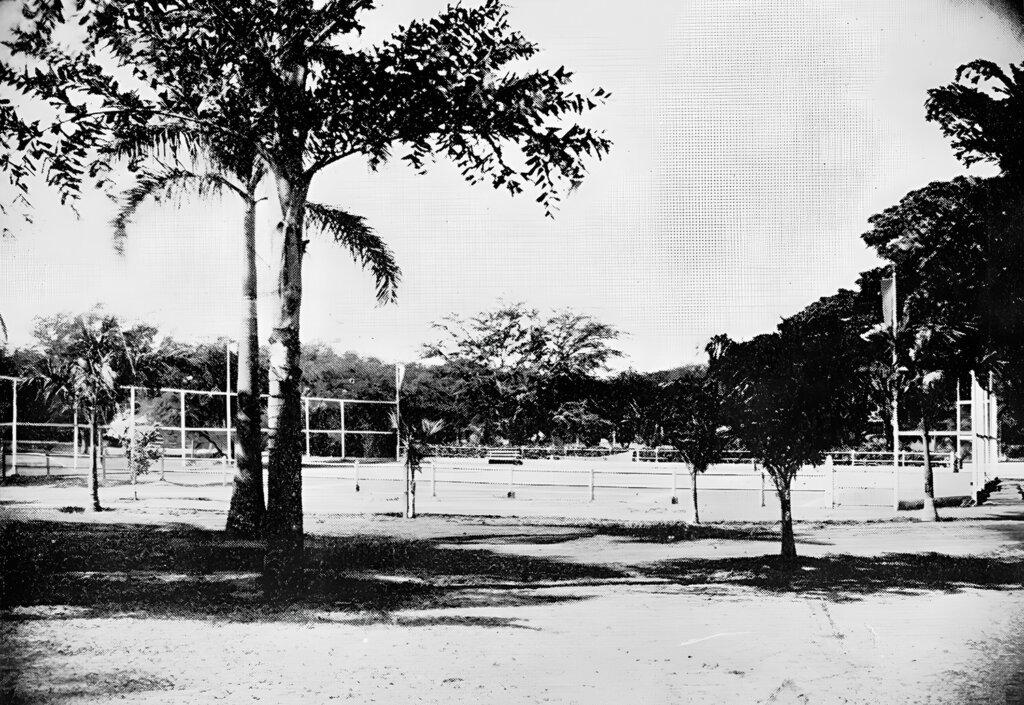
Above: The Alexander Courts, located above the Lily Pond, shown in 1911.
Main Article: Point by Point: The Making of a Legacy