


From Broad Strokes to Refined Understanding: Bringing AI Into Focus
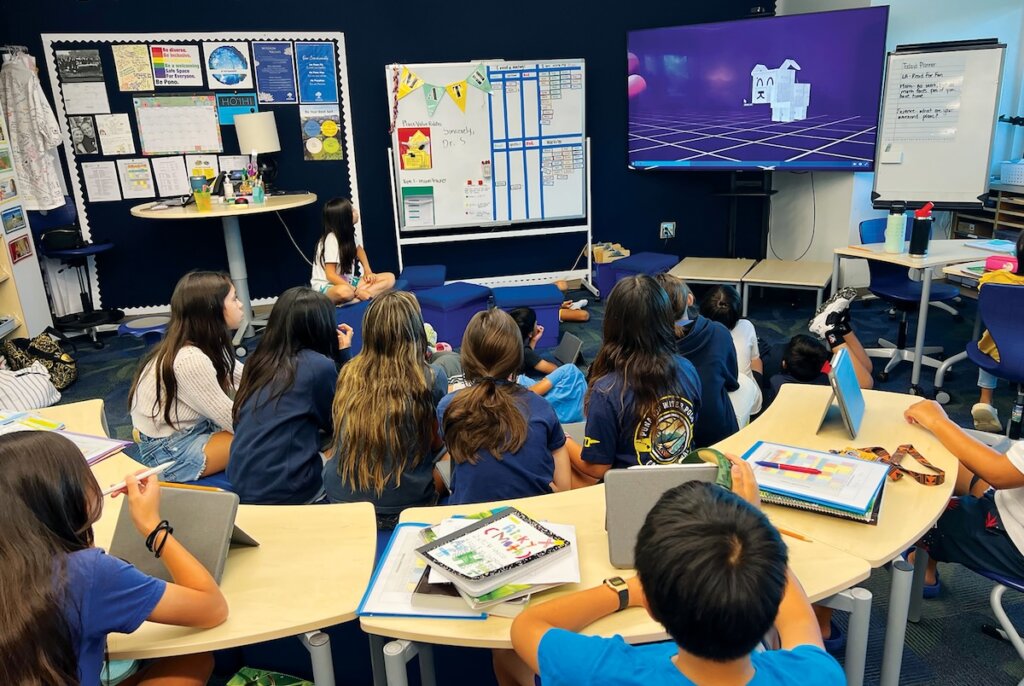
Nicole Schofield’s Grade 5 class explored AI literacy through eight engaging lessons, delving into important issues around ethics, bias and safety.
by Noelle Fujii-Oride
To say Nicole Schofield’s fifth graders embarked on a journey last year would not capture the depth of their experience. In addition to strengthening essential skills in traditional subjects like reading, math and science, they transcended from only having vague notions of what AI is to a deep exploration of how it is shaping their world.
At the onset, when asked to list examples of artificial intelligence they were familiar with, the students were only able to provide generic answers such as driverless cars, Alexa, Duolingo and ChatGPT. But after delving into AI with Schofield, they could then explain how it worked, distinguish between narrow and general AI, recognize potential biases and understand its high energy consumption.
“They’re curious, they’re going to listen, they’re not fearful, they’re excited, so it’s a good time to introduce it and play,” says Schofield, who teaches math and science. Her AI literacy unit consisted of eight lessons, made possible by a Punahou Junior School Micro Teaching-and-Learning Grant that she and Emerging Technologies Specialist Jen Roble received from the Center for Teaching and Learning.
Fifth grade is an ideal time for this work because students are exploring citizenship skills more deeply. The idea was to help students begin thinking about AI, how it shows up in daily life and ethical implications of its use.
For example, many of Schofield’s students didn’t realize that AI can be biased until she asked ChatGPT to create pictures of a teacher and a computer programmer. It generated an image of a White woman as a teacher and a man as the engineer. “We’re highlighting how important it is to be a good critical thinker, especially around AI,” Schofield says.
Schofield’s students also used AI to support their learning. She programmed Magic School, a generative AI platform for educators, to act as their “writing buddy.” The tool was especially helpful when students were asked to reflect on the jobs they performed while completing a mission at the Challenger Center Hawai‘i. If a student didn’t type in enough information, the chatbot would ask follow-up questions to encourage more details.
AI systems use a lot of energy, which can harm the environment. How can we reduce the energy AI uses to be more sustainable?
Students in Nicole Schofield’s class discussed issues such as:
If an AI system makes a mistake, who should be responsible – the people who made it, the people who use it, or the AI itself?
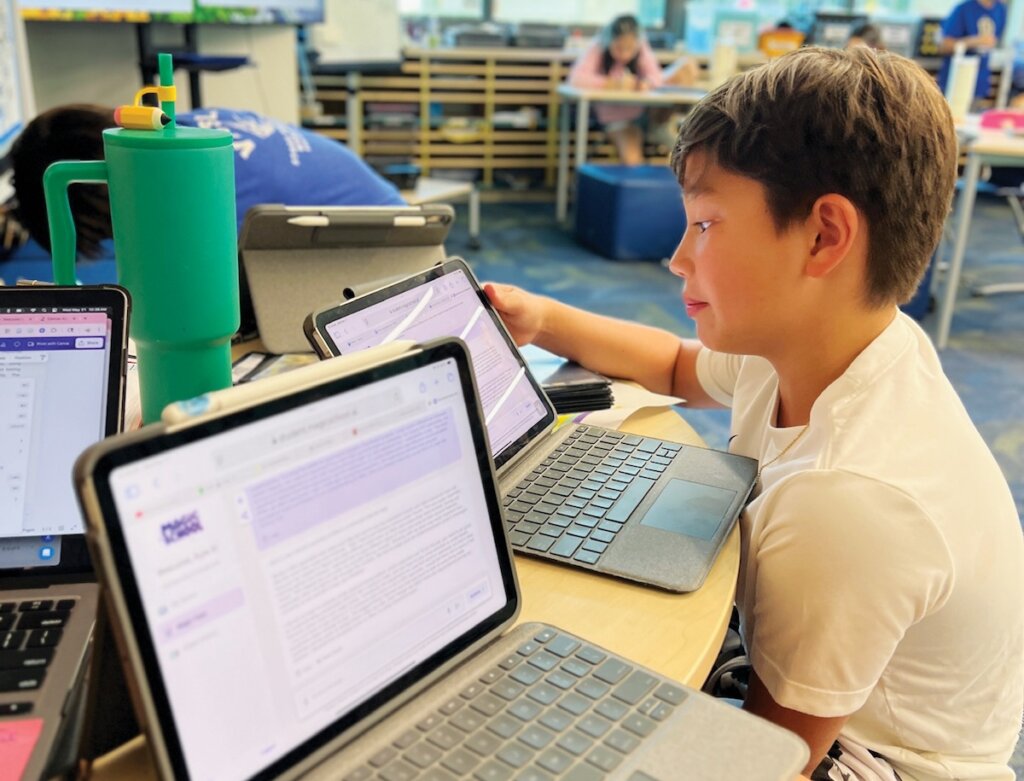
Schofield says it is opportune to have nuanced conversations around AI in Grade 5 because it is a time when students are exploring citizenship skills more deeply
Schofield’s students also used AI to support their learning. She programmed Magic School, a generative AI platform for educators, to act as their “writing buddy.” The tool was especially helpful when students were asked to reflect on the jobs they performed while completing a mission at the Challenger Center Hawai‘i. If a student didn’t type in enough information, the chatbot would ask follow-up questions to encourage more details.
The chatbot then generated a detailed summary that students used to create a one-pager describing their jobs, the character traits required and what they learned from the role.
“We were really exploring everything with the understanding that AI can be wrong, so you need to be the human in the middle,” Schofield says. “We also explored the idea that you don’t put personal info in there. It’s been especially helpful because kids get immediate feedback, and for students who have a hard time generating ideas, it allows their voices to really come through.”
Schofield added she’s mostly used AI in her classroom for nonfiction science writing, but she could see it being used as a math tutor in the future.
“I’m getting my feet wet this year, but I just really see so many possibilities next year,” she says.
If AI can do some jobs better and faster than humans, what should happen to the people who used to do those jobs?
Main Article: Prompted: Intentional AI Literacy for a New Frontier
